
Loading the latest stories…

Joan Sheridan explains the basics of turned krokbragd, simple pick-up, and Baltic pick-up on the inkle loom in the first part of weaving more than just plain-weave bands.
Joan Sheridan2 min read
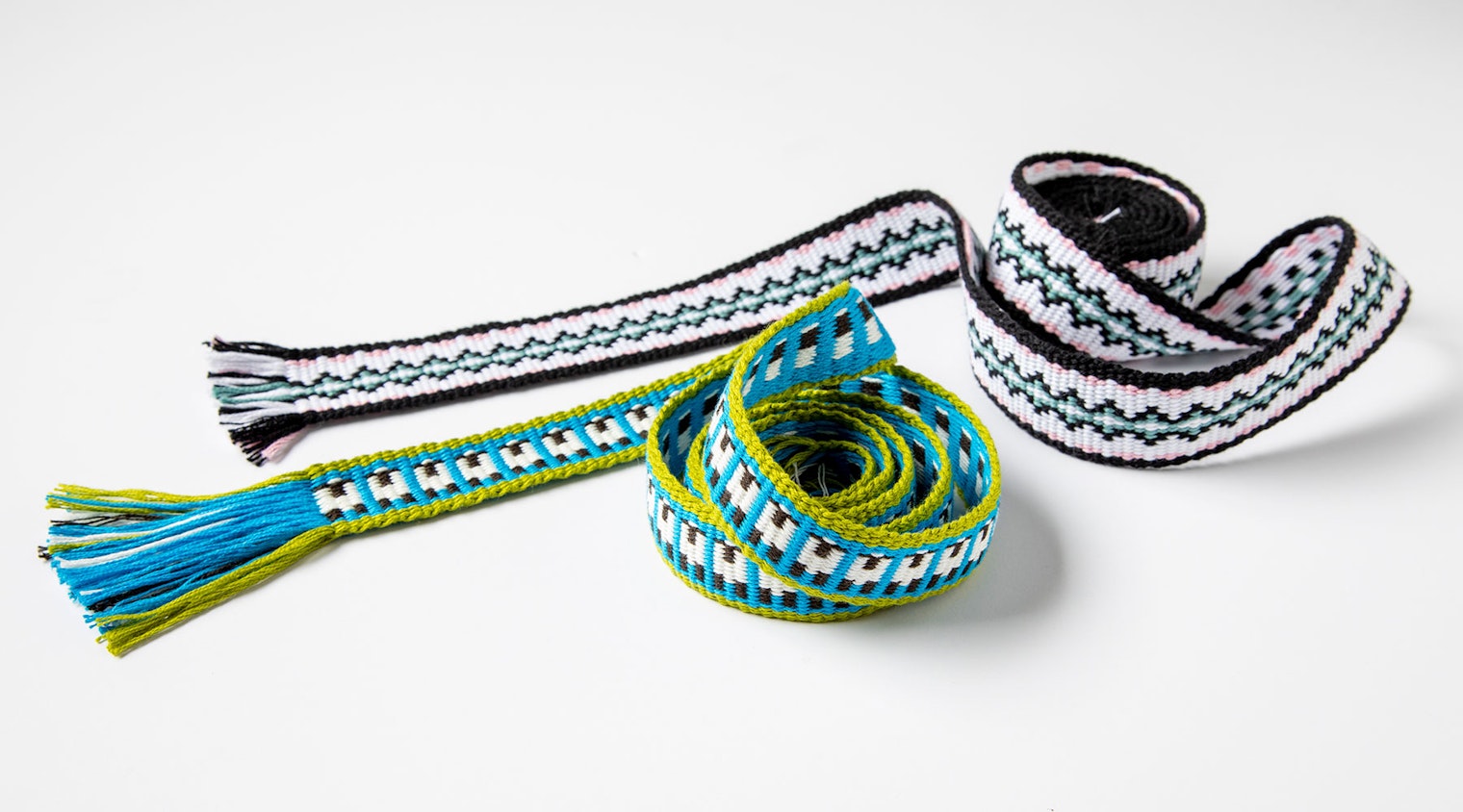
Have you ever wondered about the different techniques for creating patterns on an inkle loom? We asked Joan Sheridan, accomplished inkle weaver and teacher, to explain a few of the most common methods. For this first part, she covers turned krokbragd, simple pick-up, and Baltic pick-up. —Christina
An infinite number of color combinations can be made weaving plain-weave bands on the inkle loom. But, what’s next? Is there more that you can do? Absolutely!
Once you have the mechanics of dressing the loom and weaving a uniform band down, a good next step is to weave turned krokbragd. This is a loom-controlled weave that requires no pick-up but does provide a little latitude for patterning. You can weave figures or geometrics or even use the three sheds the structure allows and create landscapes and other nontraditional patterns. It is “tight” design—you are closely bound by the structure. Going from the possibility of two sheds to three sheds exponentially increases design potential.
The next level of making patterns on the inkle involves manipulation of the warp—which means some kind of pick-up. At the most basic, you can try pick-up on a plain-weave warp by simply picking up an unheddled warp thread and bringing it to the top when it would otherwise be in the down position. Doing this allows you to create dots and dashes and add a new dimension. With this kind of pick-up, the weft is visible on the back of the band. The thread or threads that are lifted must be woven in their normal shed every three picks, although when using very fine yarn you can stretch it to every five picks.
Baltic-style pick-up is probably the most common type of pick-up, and is often the next step for many weavers. Baltic is used in the bands of Eastern Europe, Scandinavia, and many other countries. Patterning is created by using a warp pattern thread that is twice the size of the background. Because the fabric created behind the pattern is basketweave, it is best to use the same color weft thread as the warp thread in the pattern area. The pattern thread is often wool with a background of cotton or linen. Of course, different cultures use different combinations of yarns, but this is a good place to start.
 Joan saw these examples of Baltic pick-up in a bunad shop in Norway. Notice the difference in thickness between the warp and weft. Photo by Joan Sheridan
In truth, this is not only pick-up, but also “drop off.” The pattern threads are manipulated both up and down as needed to facilitate the pattern. Starting with only five pattern threads gives good practice in moving the threads and creating the pattern. Patterns may have an even or odd number of threads, depending on the design. A pleasing pattern is created on the back of the band, making these bands two-sided. Picking up and dropping can be done with finger manipulation, a netting shuttle, or through the use of a special heddle.
Letters can be woven with this loom set up, which is a fun way to start because the pattern is already familiar and mistakes are seen quickly.
Read Part 2, where Joan will explain pebble weave. Also, if you're curious about turned krokbragd, make sure to check out Joan’s video course Weave Turned Krokbragd on an Inkle Loom.
More from Little Looms
 Skill Guide: A Weaver’s Guide to FiberNo matter what loom(s) you love to weave on, understanding the different characteristics of a fiber can help you make better choices when picking yarns for projects.Christina Garton · July 31, 2026
 Give Yourself the Gift of a Weaving GetawayWhat’s better than learning to master a new weaving? Doing it among friends, new and old! Little Looms Editors · July 21, 2026
 6 Easy Ways to Elevate Your Selvedges with TrimsAdd extra flair to your selvedges and hems with these terrific trims. Christina Garton · July 16, 2026
 A Celebration of Stripes: Call for Submissions Fall 2027We're looking for striped projects of all kinds for our Fall 2027 issue—and that includes plaids and checks, too!Christina Garton · July 9, 2026
 Designing Borders for Pick-Up BandsLearn tips and tricks for designing borders for your pick-up bands, from simple stripes to more complex color-and-weave designs. Christina Garton · July 2, 2026
 Compose a Masterpiece on Your LoomAfter all, a loom is just another type of stringed instrument. Christina Garton · June 23, 2026
 Two Ways to Make Terrific TasselsTurn loom waste or small bits of extra-special yarns into beautiful, custom-made tassels perfect for trimming handwoven projects and so much more!Christina Garton · June 18, 2026
 An Invitation to SparkleLearn three approaches for using metallic threads to weave fabric that literally shines bright! Christina Garton · June 16, 2026
 Roll the Dice on Your Next DesignFind out how easy it is to kick-start your creativity when you leave your design choices up to chance. Tommye McClure Scanlin · June 9, 2026
 My New Obsession: Three-Color Pick-up on the Inke LoomFind out how this niche Lithuanian technique found its way to America, and why it’s Christina’s new favorite way to create patterns on her inkle loom.Christina Garton · May 5, 2026
From the Library




Comments
No comments yet — be the first to share your thoughts.
Sign in to join the conversation — commenting is for signed-in members.