
Loading the latest stories…

Learn how to go from draft to a perfectly threaded set of tablets.
Little Looms Authors6 min read
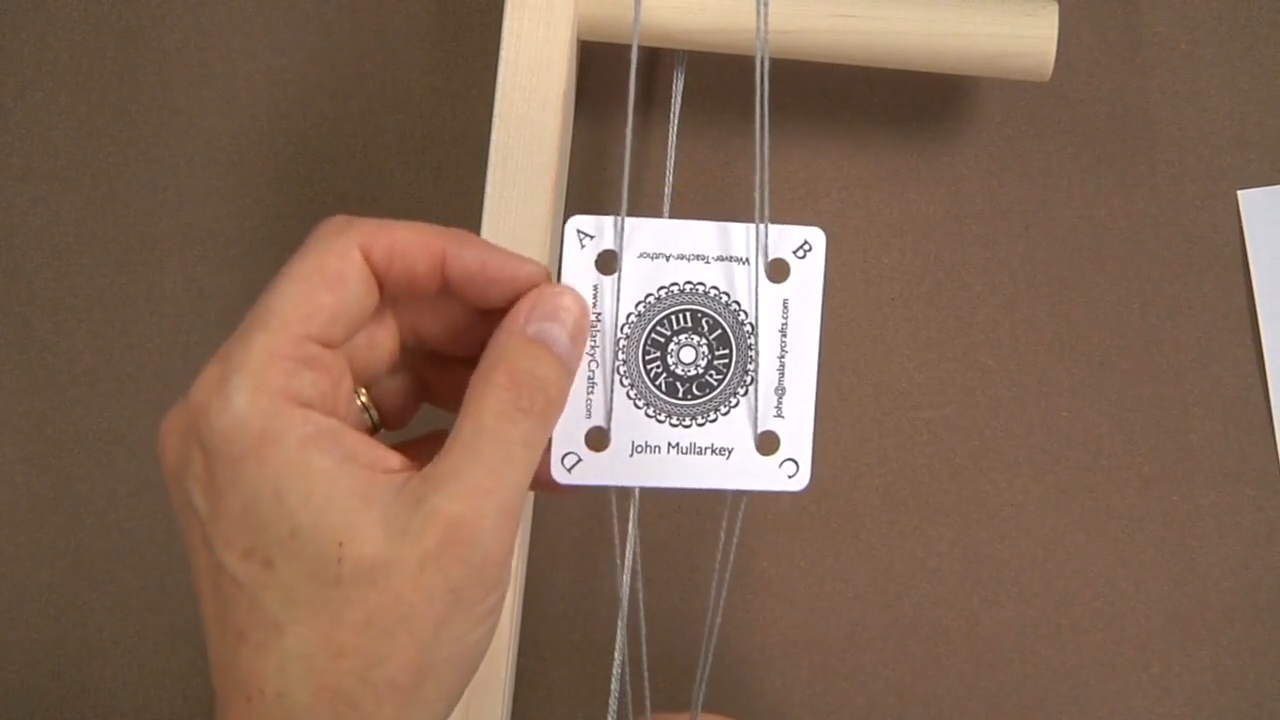

Tablet weaving might seem daunting if you've never tried it, but believe it or not, it's a fun and easy way to create complex designs with the simple turn of a card (or ten). The key to successful tablet weaving is knowing how to read a draft and how to use the information in that draft to properly thread your cards.
Today’s skill guide will give you a solid foundation on how to thread your cards correctly. As you read, you’ll learn about:
Knowing how to read a tablet draft and thread your cards correctly is such an important part of tablet weaving, we’ve made the first section of this skill guide free to everyone. If you enjoy that first section and want to read more, consider supporting our mission with an All Access subscription. Not only will you get this full skill, but you’ll also get dozens of other skill guides, exclusive projects, eBooks, and other perks. You can read more about our different subscription tiers and benefits here.
Every item we’ve selected for this guide is part of your All Access program and will help you get the most out of your subscription. Check out the Little Looms Library and our video course website for more learning opportunities.
Happy Weaving,
Christina
While different tablet weavers and tablet-weaving resources use different formats for their drafts, any draft format should give you all the information you need to weave the pattern: number of tablets, holes, and colors as well as how each card should be threaded.
Below is an example of a draft from John Mullarkey’s Astounding Laces from the Summer 2021 issue. Each number at the top of the draft represents a different tablet—the draft is numbered 1–10, which lets us know we’ll need ten cards. The letters on the left side represent the four holes on a square tablet. Each colored box in the grid represents a different warp end and what color it should be. Looking at the draft, we can tell what color end goes through each hole of any given tablet. For example, the first tablet has charcoal ends in all four holes; the second tablet has two charcoal ends, one each in holes A and C, and two orange-yellow threads, one each in holes B and D.
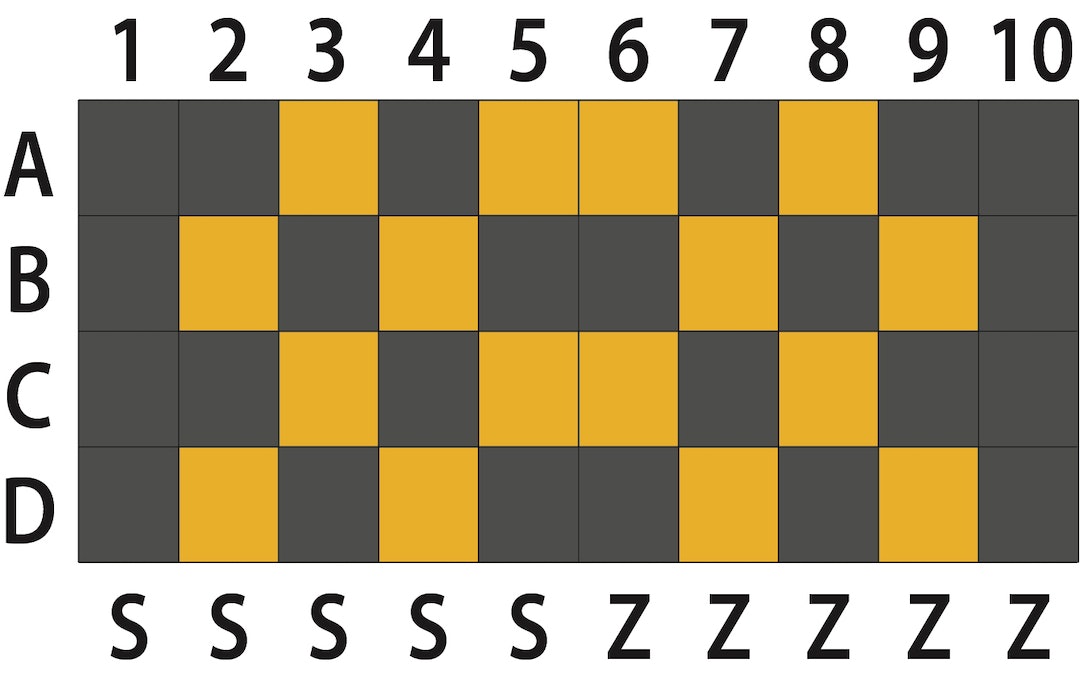
Now that you know how to use a tablet draft to figure out how many tablets you need and which colored threads go in which holes, the next step is deciphering the letters on the bottom of the draft.
Underneath each column is either an “S” or a “Z.” These letters tell us how to thread each tablet. In this draft, tablets 1–5 are threaded with an S-slant, and tablets 6–10 are threaded with a Z-slant. But what does that mean, exactly?
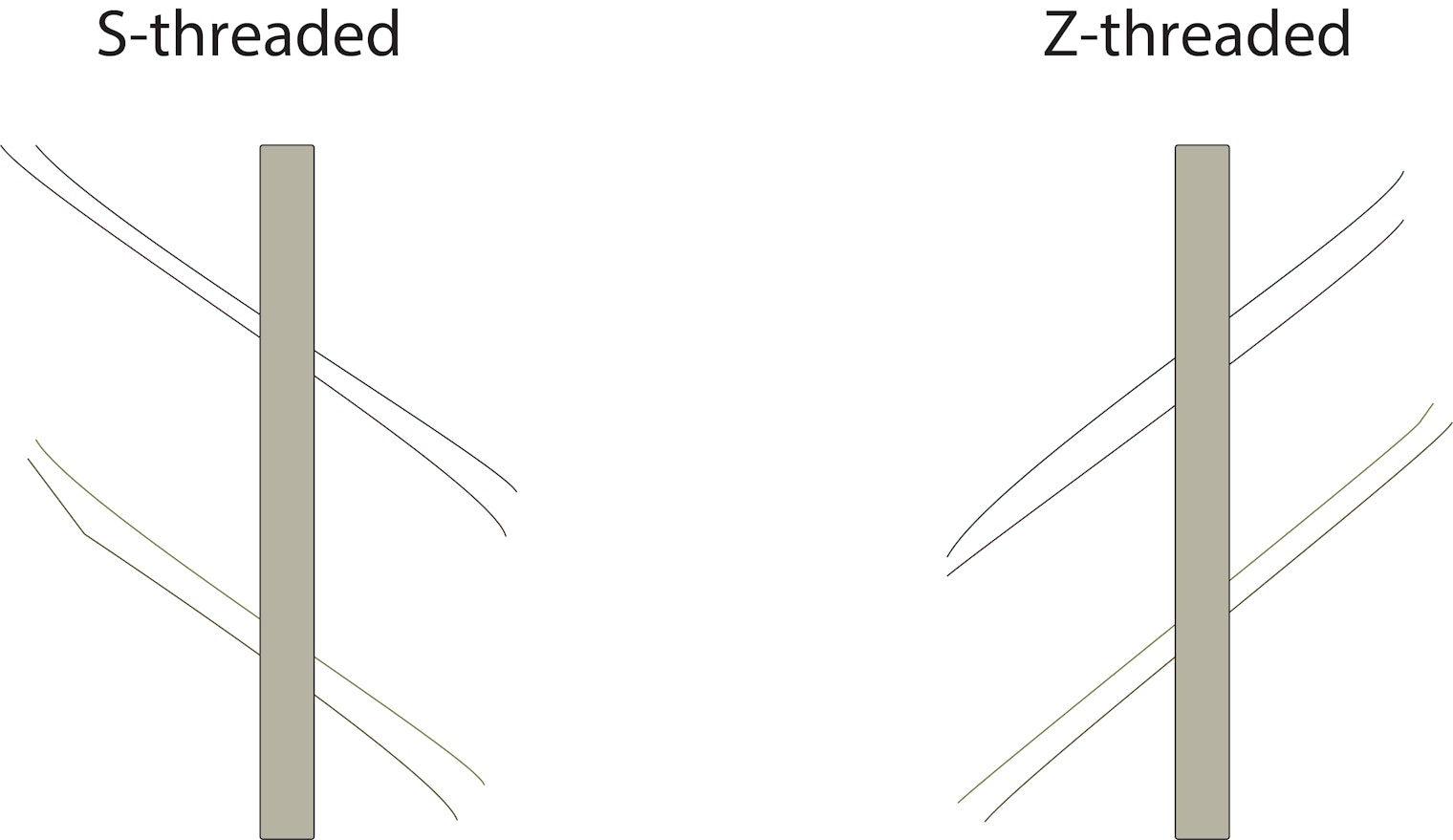
Depending on the direction you thread each card, the warp ends will slant in a different direction. The S or the Z refers to the slant of the threads when the tablet is held straight and viewed from the front of the loom:
As you might be able to tell, the direction of the slant matches the direction of the slant in its namesake letter, which you can see more clearly in the illustration below.
Another way to tell whether a tablet is threaded S or Z is to look at the direction the tablets naturally slant when the warp is at tension. Tablets will slant in the opposite direction of the ends, so in this case, if your tablets have a / slant it’s an S-threading and a \ slant in the tablets is a Z-threading, as shown in the illustration below.
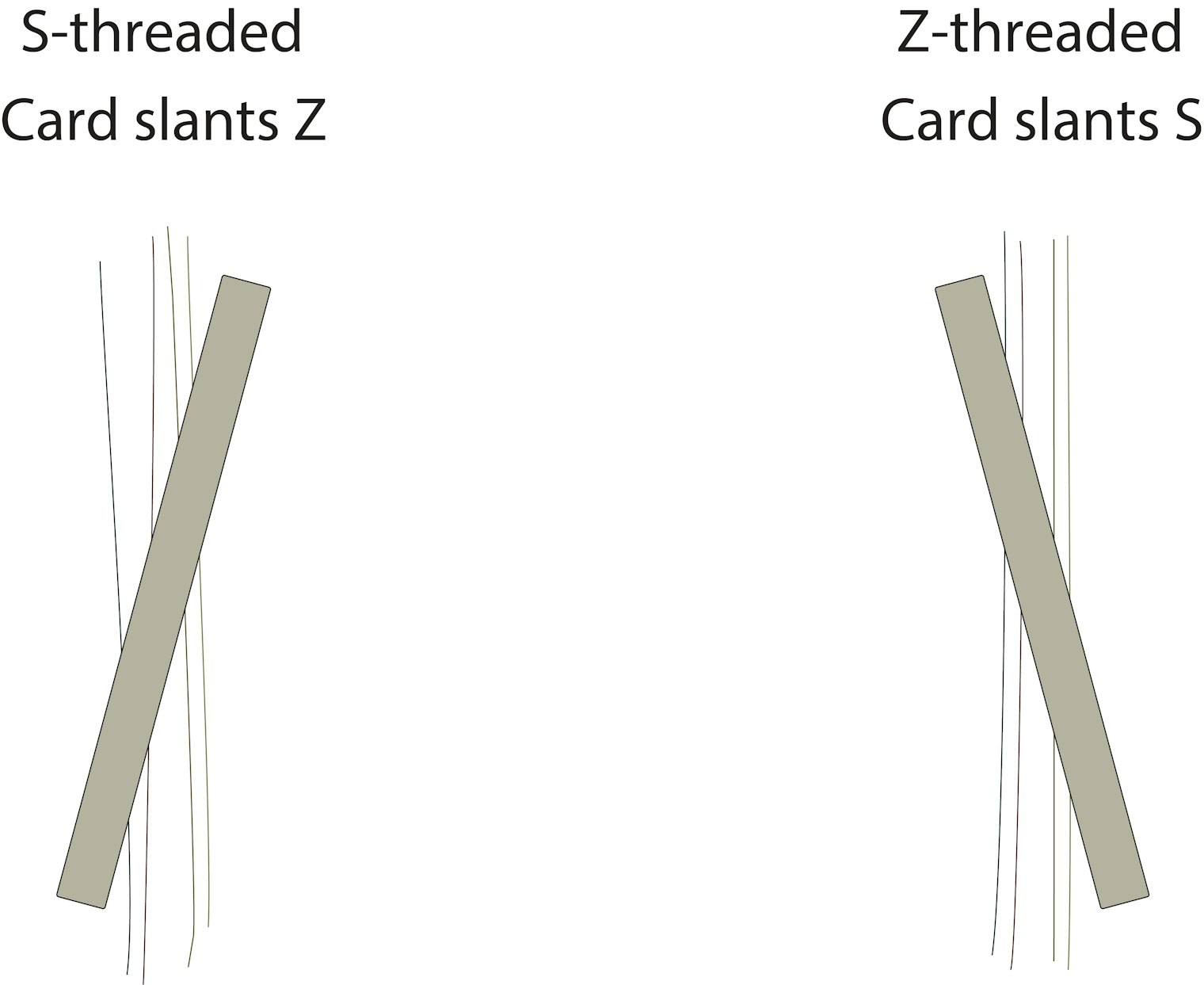
Unless your pattern is reversible, it’s imperative to thread your tablets in the correct slant direction. Fortunately, once you know how to not only read a draft, but also how to “read your tablets,” making sure your tablets are set up correctly is a piece of cake!
Adapted from "Tablet Weaving: Threaded in Patterns" by John Mullarkey
All patterns develop from two simple elements: which color comes to the top of the band after each turn of the tablets and the ply direction of the four-ply cord created by twisting each tablet. That’s it! Once you can predict those two things, you can produce any pattern.
More from Little Looms
 Skill Guide: A Weaver’s Guide to FiberNo matter what loom(s) you love to weave on, understanding the different characteristics of a fiber can help you make better choices when picking yarns for projects.Christina Garton · July 31, 2026
 Tutorial: Continuous-Strand WeavingLearn the basics of using the continuous strand–weaving method on a pin loom.Jennifer Chapman · July 30, 2026
 Twill for the Rigid-Heddle Loom: It’s Easier Than You Think!Learn why weavers love twill—and what makes it a great weave for the rigid-heddle loom.Christina Garton · July 14, 2026
 Long Thread Podcast: Angela Tong, Multidisciplinary MakerSeason 14, Episode 7: A jeweler, knitter, crocheter, weaver, and potter sit down for a chat—and it turns out she's the same person. Angela Tong talks about a creative life built on detail, technique, and staying true to her own voice.Anne Merrow · May 2, 2026
 Long Thread Podcast: Heather Torgenrud, Pick-Up BandweavingSeason 14, Episode 4: Although her weaving interests vary from Anne Merrow · March 21, 2026
 Long Thread Podcast: Christina Garton, Little LoomsSeason 14, Episode 2: Ten years since the first issue of Easy Weaving with Little Looms, editor Christina Garton is still finding delightful new ideas in small-loom weaving.Anne Merrow · February 21, 2026
 Weave a Pin-Loom Pet for National Love Your Pet DayWeave a pet—all it takes is a pin loom, a few put-ups of yarn, and a copy of Zoo Crew. Christina Garton · February 12, 2026
 Long Thread Podcast: Laverne Waddington (classic)Season 13, Episode 8: Using her hands, fine threads, and simple tools, Laverne Waddington uses backstrap looms to explore a world of weaving techniques and traditions.Anne Merrow · December 27, 2025
 Skill Builder: Explore Two Takes on Textured WeavesCraving more visual interest in your projects? Try these simple pick-up patterns to add texture to your weaving.Christina Garton · December 18, 2025
 Call for Submissions! Winter 2026: Wonderful WoolIn this issue, we’re looking for projects that highlight the beauty and versatility of wool and wool blends. Christina Garton · November 4, 2025
From the Library




Comments
No comments yet — be the first to share your thoughts.
Sign in to join the conversation — commenting is for signed-in members.