
Loading the latest stories…


Christina shares some of her techniques for weaving intermediate tablet-weaving patterns.
Christina Garton3 min read
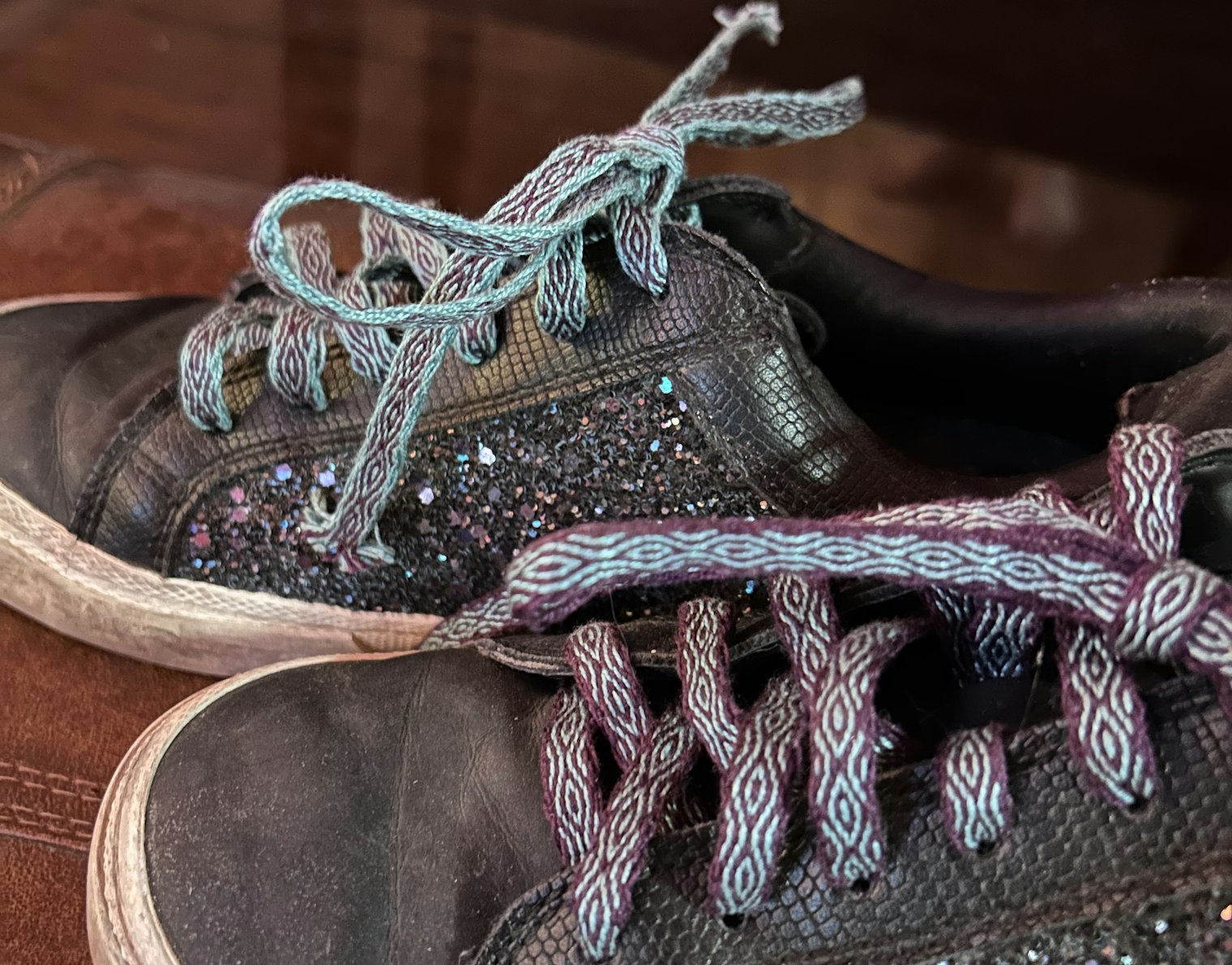
While at Weave Together with Handwoven, I had the distinct pleasure of getting to take John Mullarkey’s Tablet-Woven Shoelaces class. Before taking the class, I had never warped an inkle loom for tablet weaving, nor had I woven anything following a tablet-weaving pattern. I was shocked to find out it was relatively easy (no, really!).
Since then, I’ve warped and woven a set of shoelaces using the simple draft John gave us (and the same draft you can find in his project Astounding Laces in the Summer 2021 issue.) While I loved weaving the shoelaces, I wanted to try a more complicated pattern, one that required me to do more than forward 4, backward 4.
I chose a pattern from John’s book about Egyptian diagonals, warped my loom, and got started weaving. Thanks to the sticky Tencel warp I put on (Pro tip: Don’t use Tencel for your first intermediate tablet-weaving project), I had issues from the start. Cards would get stuck and not turn all the way, and I wouldn’t notice until I saw the error in my weaving. Thanks to my ADHD and lack of short-term memory, I was constantly forgetting whether I’d turned the cards once or twice and which set of cards I’d turned. It soon became clear I needed some strategies. Here are some tips I use to help me with tablet weaving.
These more advanced designs required me to turn some cards forward and some cards backward. Unfortunately, I kept forgetting which set I’d turned and which still needed turning. So, I made a new rule. Before turning cards get separated into forward- and backward-turn groups, one I moved to the back of the loom, one I moved forward. Then, no matter what, I always turn the forward group first.
Clockwise from top left: Christina’s first attempt at weaving Egyptian diagonals next to the photo in John’s book; an intermediate pattern woven in two shades of pink and iridescent filament; Christina’s current project, which is being woven upside down; the finished pink band turned into a wristlet for a favorite bag. Get a closer look! Click any image in the gallery above to open it in full-screen mode.
I love using color and other visual cues to help me tell at a glance what’s going on. I put the cards in the starting position and used a pink highlighter to color the side facing me as well as the opposite side, and then I used a blue highlighter to color the other two sides, so as I turned the cards, they went pink, blue, pink, blue. Then, on the pink sides, I added a black stripe only on the two center cards. Now I could easily find the center and know whether a card didn’t turn when it was supposed to. If you don’t want to permanently mark your cards, I bet painter’s tape or colored pencils would work well, too.
The patterns in the book don’t include borders, but I kept forgetting that fact and would count border cards as part of the pattern. This meant I’d end up turning one pattern card when I was supposed to turn two. I grabbed my trusty highlighters and added a column for the border on either side of the draft. Now every time I looked at the draft, I was instantly reminded to mind my borders.
I learned a lot while weaving my Egyptian diagonal sampler band, and since then I’ve kept both my inkle looms warped and have even started playing with iridescent filaments. I even successfully wove a band for a wristlet that had 64 rows before the pattern repeated! While I don’t claim to be close to an expert weaver—I mixed up the S- and Z-threadings on my most recent warp and am weaving it upside down—I am fully hooked on tablet weaving and can’t wait to learn more.
Happy Weaving!
Christina
More from Little Looms
 Skill Guide: A Weaver’s Guide to FiberNo matter what loom(s) you love to weave on, understanding the different characteristics of a fiber can help you make better choices when picking yarns for projects.Christina Garton · July 31, 2026
 Give Yourself the Gift of a Weaving GetawayWhat’s better than learning to master a new weaving? Doing it among friends, new and old! Little Looms Editors · July 21, 2026
 A Celebration of Stripes: Call for Submissions Fall 2027We're looking for striped projects of all kinds for our Fall 2027 issue—and that includes plaids and checks, too!Christina Garton · July 9, 2026
 Compose a Masterpiece on Your LoomAfter all, a loom is just another type of stringed instrument. Christina Garton · June 23, 2026
 Two Ways to Make Terrific TasselsTurn loom waste or small bits of extra-special yarns into beautiful, custom-made tassels perfect for trimming handwoven projects and so much more!Christina Garton · June 18, 2026
 Long Thread Podcast: Angela Tong, Multidisciplinary MakerSeason 14, Episode 7: A jeweler, knitter, crocheter, weaver, and potter sit down for a chat—and it turns out she's the same person. Angela Tong talks about a creative life built on detail, technique, and staying true to her own voice.Anne Merrow · May 2, 2026
 Summer Weaving for Any OccasionDiscover a collection of cool projects for warm weather in Little Looms Summer 2026!Christina Garton · March 31, 2026
 Join the Band: A New Retreat Just for BandweaversJoin us this fall for four days of bandweaving fun at Band Camp for Weavers!Christina Garton · March 24, 2026
 Long Thread Podcast: Heather Torgenrud, Pick-Up BandweavingSeason 14, Episode 4: Although her weaving interests vary from Anne Merrow · March 21, 2026
 Little Looms is Turning 10!Celebrate ten years and twenty-five issues of Little Looms with a look back at the first issue—and a free project!Christina Garton · March 19, 2026
From the Library


Comments
No comments yet — be the first to share your thoughts.
Sign in to join the conversation — commenting is for signed-in members.