
Loading the latest stories…


Rigid heddles are wonderful tools for bandweaving, once you know how to use them. Watch an exclusive video featuring Spin Off’s Kate Larson to learn how to warp and weave on a rigid heddle, no loom required!
Christina Garton2 min read
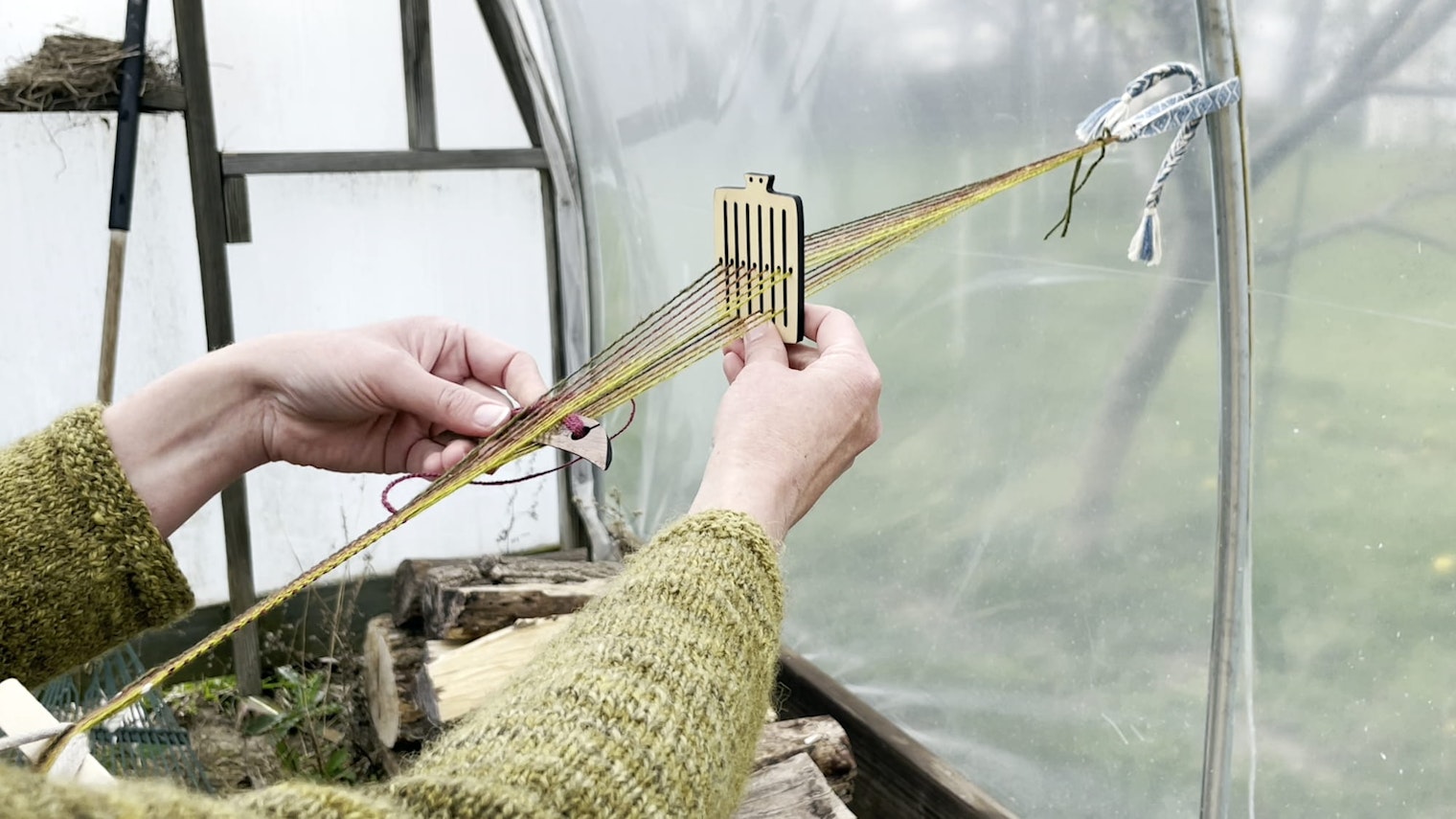
I love the idea of bandweaving, but I don’t love the idea of making string heddles. I know, I know. In the grand scheme of things, it doesn’t take all that long, but I often have an hour or less of actual free time in a day and want to spend as much of that time weaving as possible. Recently I was reminded of an old tool, the rigid heddle.
I’m not talking about the rigid-heddle loom but rather the traditional bandweaving tool. These heddles look a bit like their rigid-heddle loom counterparts and work in the same sort of way. Warp ends are pulled through slots and holes on the heddle, which is then lifted or lowered to create a shed—no string heddles (or loom!) required. Some heddles even have multiple layers of slots and/or holes so you can warp once and create multiple sheds without pick-up (although you can use pick-up with a rigid heddle as well).
 Rigid heddles come in a variety of sizes and styles. Photo credit: Kate Larson
So how exactly do you set up and use one of these handy little heddles? Lucky for all of us, the amazing Kate Larson, editor of our sister magazine Spin Off, recently put out a video explaining how to warp and weave on a rigid heddle. In Backstrap Rigid Heddle Basics, Kate shows you how she uses her rigid heddle without a loom using a simple, easy-to-replicate backstrap loom. Of course, don’t take my word for it—watch the video below!
I hope you found this video as fascinating and inspiring as I did. In fact, I liked this video so much I bought my own simple rigid heddle. I can’t wait to try it out this weekend. If it works out, I see so much potential for weaving on the go.
Happy Weaving!
Christina

TheDancingGoats makes historic and prehistoric reproductions, and re-imaginings of fiber arts tools. Focusing on the prehistoric textile traditions of the Northern Roman Provinces, the Northern Isles, and Western Europe. Shuttles, heddles, looms, spindles, and whorls. Tools are made in wood, stone, pewter, copper alloys, ceramics, and glass. The company’s advanced CNC Laser is dedicated to making fiber arts tools and folklore inspired creations. TheDancingGoats business model is Inspired by Albrecht Durer’s life, journals, and his Nuremberg School. Learning, teaching and practicing the Heritage Arts since 1987. Learn more at TheDancingGoats.Etsy.com.
More from Little Looms
 Skill Guide: A Weaver’s Guide to FiberNo matter what loom(s) you love to weave on, understanding the different characteristics of a fiber can help you make better choices when picking yarns for projects.Christina Garton · July 31, 2026
 Give Yourself the Gift of a Weaving GetawayWhat’s better than learning to master a new weaving? Doing it among friends, new and old! Little Looms Editors · July 21, 2026
 6 Easy Ways to Elevate Your Selvedges with TrimsAdd extra flair to your selvedges and hems with these terrific trims. Christina Garton · July 16, 2026
 A Celebration of Stripes: Call for Submissions Fall 2027We're looking for striped projects of all kinds for our Fall 2027 issue—and that includes plaids and checks, too!Christina Garton · July 9, 2026
 Designing Borders for Pick-Up BandsLearn tips and tricks for designing borders for your pick-up bands, from simple stripes to more complex color-and-weave designs. Christina Garton · July 2, 2026
 Compose a Masterpiece on Your LoomAfter all, a loom is just another type of stringed instrument. Christina Garton · June 23, 2026
 Two Ways to Make Terrific TasselsTurn loom waste or small bits of extra-special yarns into beautiful, custom-made tassels perfect for trimming handwoven projects and so much more!Christina Garton · June 18, 2026
 An Invitation to SparkleLearn three approaches for using metallic threads to weave fabric that literally shines bright! Christina Garton · June 16, 2026
 Roll the Dice on Your Next DesignFind out how easy it is to kick-start your creativity when you leave your design choices up to chance. Tommye McClure Scanlin · June 9, 2026
 My New Obsession: Three-Color Pick-up on the Inke LoomFind out how this niche Lithuanian technique found its way to America, and why it’s Christina’s new favorite way to create patterns on her inkle loom.Christina Garton · May 5, 2026
From the Library


Comments
No comments yet — be the first to share your thoughts.
Sign in to join the conversation — commenting is for signed-in members.