
Loading the latest stories…

If you spin your own yarn consider picking up a pin loom if you haven't already. Read more about why handspun yarn and pin looms go hand-in-hand.
Debbie Held3 min read
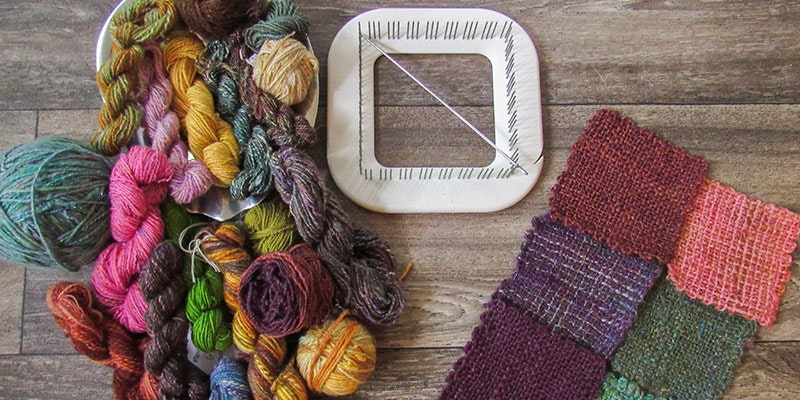
From the moment I began weaving two years ago, I did so using my handspun and a 4 x 4-inch hand-held pin loom. Still today, despite my love affair with the rigid-heddle loom and learning to dress my new-to-me table loom, I use my pin loom for weaving at least weekly.
“But what do you do with all those squares?” is what most people want to know. For me, a near-daily spinner, my pin loom crush isn’t so much about the completed squares as the knowledge I gain from creating each one.
If you’ve ever wondered about the attraction such a small loom holds, pins or no, particularly for handspinners, here are my two cents on the matter.
1. Perfect craft break Like many, I have days in which I can craft for only a few precious moments. Weaving a pin-loom square takes me roughly 20 minutes from warp to finish, and I enjoy not only the sense of having accomplished a Small Thing, but also the feeling of calm that working with my handspun brings me.
2. Spindle candy I love to spindle spin, and no fiber sample is safe from my spindle collection. Spinning 5–20 grams of fiber per spindle, I can try bits of interesting fibers and then use them to weave one or more squares.
3. Yarn economy Because it takes only 8 or so yards of yarn to weave a 4" square, why not weave with small lengths of handspun yarn? No handspinner wants to waste his or her precious handspun scraps.
4. Spinning education Weaving a small bit of fabric with various handspun yarns teaches me a great deal about their differences and similarities in elasticity, density, strength, luminescence, and more. I can see how my pre-spinning fiber preparations and drafting choices impact a plain weave. I think of it as general sampling, and I get to add more knowledge to my spinning and weaving toolboxes.
5. Repetition breeds creativity Time spent lost in the repetitive steps of weaving always helps to open my creative floodgates. It’s in these moments that I think of my next article submissions and design ideas. When I’m suffering from writer’s block or feeling unfocused, this small bit of crafting time brings me back to center. I’ll bet you would have similar results in your own field!

The beginning of a handspun, handwoven afghan.
Now, about what I do with my completed squares: I plan on invisibly seaming them together to form an afghan. The key will be seaming them in as I go and not waiting until the end (ugh). This way I’ll also be able to use and display it as the blanket grows. (Curious how to weave on a pin loom? Check out our tutorials on pin-loom weaving and seaming pin-loom squares with whip stitch.)
As you can see from my overflowing stash of handspun mini-skeins and leftovers, the color palette all works fairly well together. This is the case for most of our stashes, as we all have a tendency to purchase and then spin colorways that we find enticing. As for the yarn’s gauge, it’s okay to use a flexible range for this blanket project—a 4-inch square is a 4-inch square—though my collection here is mainly fingering weight spun worsted, woolen, and all the semis in between. Any variance will be dispersed over a larger fabric landscape, and that should work in my favor.
Time will tell, right? In the meantime, I’ll continue to enjoy the huge benefits of weaving with my little square pin loom. I hope you’ll give one a try!
—Debbie Held
More from Little Looms
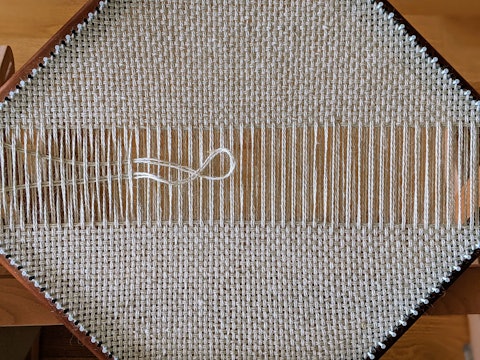 Tutorial: Continuous-Strand WeavingLearn the basics of using the continuous strand–weaving method on a pin loom.Jennifer Chapman · July 30, 2026
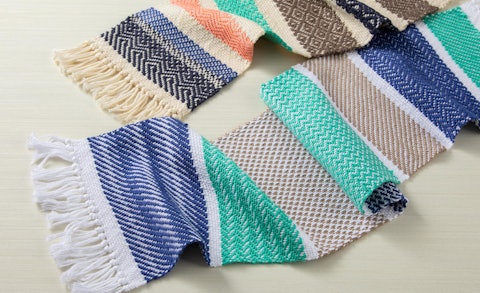 Twill for the Rigid-Heddle Loom: It’s Easier Than You Think!Learn why weavers love twill—and what makes it a great weave for the rigid-heddle loom.Christina Garton · July 14, 2026
 Dealing with Selvedges that Go BumpLace weaves are notorious for creating uneven, scalloped, and overall lumpy-bumpy selvedges. Learn two different methods for handling these selvedges in the first installment of our Summer Selvedge Series. Christina Garton · June 4, 2026
 My New Obsession: Three-Color Pick-up on the Inke LoomFind out how this niche Lithuanian technique found its way to America, and why it’s Christina’s new favorite way to create patterns on her inkle loom.Christina Garton · May 5, 2026
 Long Thread Podcast: Angela Tong, Multidisciplinary MakerSeason 14, Episode 7: A jeweler, knitter, crocheter, weaver, and potter sit down for a chat—and it turns out she's the same person. Angela Tong talks about a creative life built on detail, technique, and staying true to her own voice.Anne Merrow · May 2, 2026
 Get Started: Read a Basic Rigid-Heddle PatternHere's what you'll see in a rigid-heddle pattern in Little Looms—and how to translate that information to the loom!Christina Garton · April 23, 2026
 Up Your Design Game with the Fibonacci SequenceLearn how easy it is to design beautiful, asymmetric patterns using a simple bit of math. Christine Jablonski · April 21, 2026
 Perfectly Portable Looms for Weaving on the GoInterested in weaving on small looms? Learn how easy it is to build your own tiny weaving studio and sampler looms using simple household items. Elizabeth Jensen · March 26, 2026
 Join the Band: A New Retreat Just for BandweaversJoin us this fall for four days of bandweaving fun at Band Camp for Weavers!Christina Garton · March 24, 2026
 Long Thread Podcast: Heather Torgenrud, Pick-Up BandweavingSeason 14, Episode 4: Although her weaving interests vary from Anne Merrow · March 21, 2026
From the Library




Comments
No comments yet — be the first to share your thoughts.
Sign in to join the conversation — commenting is for signed-in members.