
Loading the latest stories…


Have you ever wanted to weave with luxurious yarns but were too scared to try? Learn some tips and tricks for approaching extra-special yarns, and how you can win a prize by doing so!
Christina Garton4 min read

When we talk about luxury yarns, we’re not just talking about a price tag. Instead, we’re referring to yarns including cashmere, yak, qiviut, and silk (to name a few) that require a great deal of work and skill to go from fiber source to yarn. Harvesting these fibers often takes more work than simply shearing a sheep, and they can also take more time to process post-harvest. Cashmere, for example, is the down undercoat of certain breeds of goats; it must be carefully harvested to keep the soft down separate from the coarse guard hairs that grow around it. On its own, cashmere is an absolutely luscious fiber, but the amount of work it takes to get from the goat to your yarn store takes it to another level of special.
Given how special these yarns are, it can often be scary when it comes time to weave with them for the first time. Many of us have a special skein of something languishing in our stashes, kept off the loom for the fear of wasting it. Instead of keeping that yarn on your shelf, I would like to encourage you to weave with it. Don’t know where to start? Don’t worry! Here are five tips for weaving with extra-special yarns and information on how you can win fabulous prizes by doing so!
Before weaving with a single-fiber luxury yarn, try a yarn that blends an extra-special fiber with something more familiar. For example, if you’re interested in trying cashmere, a merino/cashmere blend like the one used by Elisabeth Hill in her Taconic Tonic Scarf (pictured at top) might be a good first choice. Blends are often the best of both worlds and a great entry into trying new fibers.
 Special yarns can really shine when used as the pattern thread in inkle pick-up techniques. Photo by Matt Graves
If you’re weaving on a rigid-heddle loom and worry about warping, you can always use your luxury yarn in just the weft. You don’t even need to use it for the entirety of the weft. If you have only a small amount of yarn, consider using it in stripes of overshot pick-up or for a bit of inlay. If inkle weaving is more your speed, try using fancy fibers as the pattern yarn in a sturcture such as Baltic pick-up, where it will really shine—even in small amounts. Just make sure no matter which loom or weaving technique you use that you pair it with a fiber that will not cause differential shrinkage or other issues after wet-finishing.
Most luxury yarns are strong enough to use in the warp, but fears of fibers abrading and of loom waste are enough to scare off some weavers. To help prevent the yarn from rubbing the heddle too much, try using sizing, a temporary coating designed to protect yarns while weaving that is removed during wet-finishing. For reducing warp waste, you can use a technique known as lashing that has the added benefit of improving tension. Find step-by-step instructions for lashing here.
 Gabi van Tassell used pin looms to weave her luxurious qiviut cowl. Photo by Matt Graves
While we don’t often associate pin looms with luxury fibers, I’d like to see that change because pin looms and fancy fibers are a match made in weaving heaven. Pin looms are quick and easy to weave on and have little to no weaving waste (especially if you use the tails to join shapes). Because each pin loom piece uses only a small amount of yardage, it’s a great way to use up small amounts of fiber. For her qiviut cowl, for example, Gabi van Tassell paired a 100% qiviut yarn with a qiviut/silk blend and was able to weave a beautiful piece with less than 2 ounces of fiber!
You didn’t think I’d get through the article without mentioning the importance of sampling, did you? The best way to avoid tears to is to sample first—that means weaving and wet-finishing. This is especially important if you’re combining fibers—differential shrinkage can be beautiful, but not when it’s unwanted and unplanned. Weave up a small swatch in your chosen sett (pin and swatch looms are great for this), take measurements and make notes, wet-finish it, and take more notes and measurements. What you learn will not just help you with your current project, but also with future projects using the same or similar fibers.
Did you know that many of the communities that harvest many of the extra-special fibers we know and love—including cashmere—depend on what are now rapidly melting glaciers? As these glaciers melt, water resources in the areas where so many special fiber animals are raised can dwindle, making it hard for humans and animals alike to survive in these regions. Some of those affected include the Pangong Craft Center in Ladakh, India, known for its incredible cashmere fiber and yarn.
To highlight the importance of glaciers, the United Nations General Assembly has named 2025 the International Year of Glaciers’ Preservation, and we at Long Thread Media along with our friends at Wild Fiber are hoping to raise awareness about the importance of glaciers with our Cashmere on Ice contest where you can win a prize just for weaving with cashmere. We’re looking for original pieces created using cashmere (blends included!) and will be giving prizes in four categories: Best Wearable, Best Art or Décor, The Best of Ladakh, and People’s Choice. Learn more about each category, prizes, and how to enter at Cashmere on Ice. The deadline to enter is September 1, 2025, so you’ve still got plenty of time to sample and weave (or knit or crochet). I hope you join in on the cashemere fun!
Happy Weaving!
Christina
More from Little Looms
 Skill Guide: A Weaver’s Guide to FiberNo matter what loom(s) you love to weave on, understanding the different characteristics of a fiber can help you make better choices when picking yarns for projects.Christina Garton · July 31, 2026
 From WIF to Woven ClothLearn how to use WIFs and weaving software to create and edit patterns—before you put a single thread on the loom. Christina Garton · July 23, 2026
 Give Yourself the Gift of a Weaving GetawayWhat’s better than learning to master a new weaving? Doing it among friends, new and old! Little Looms Editors · July 21, 2026
 6 Easy Ways to Elevate Your Selvedges with TrimsAdd extra flair to your selvedges and hems with these terrific trims. Christina Garton · July 16, 2026
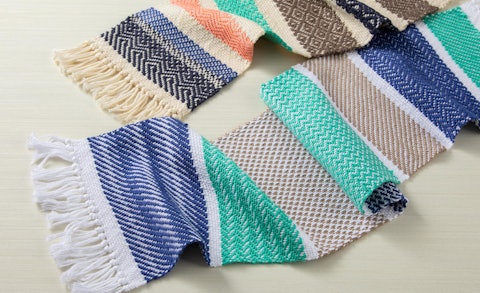 Twill for the Rigid-Heddle Loom: It’s Easier Than You Think!Learn why weavers love twill—and what makes it a great weave for the rigid-heddle loom.Christina Garton · July 14, 2026
 A Celebration of Stripes: Call for Submissions Fall 2027We're looking for striped projects of all kinds for our Fall 2027 issue—and that includes plaids and checks, too!Christina Garton · July 9, 2026
 Make Your Own Cardboard Mini-ShuttlesButterflies are beautiful, but they’re not always the best choice when you’re weaving. Try winding small bits of weft on these simple, DIY cardboard shuttles instead!Christina Garton · July 7, 2026
 A Trio of Table ToppersGo beyond rectangular runners with table toppers. Christina Garton · June 30, 2026
 Crochet for Your Selvedges? Your Edges Will Thank YouFind out why Sara Bixler finishes some of her woven pieces with crochet. Watch her free video clip, and then dive into several stitch options to try on your next project. Little Looms Editors · June 25, 2026
 Compose a Masterpiece on Your LoomAfter all, a loom is just another type of stringed instrument. Christina Garton · June 23, 2026
From the Library


Comments
No comments yet — be the first to share your thoughts.
Sign in to join the conversation — commenting is for signed-in members.