
Loading the latest stories…

Random warping is harder than you might think! Learn how Christina approached random color changes in her Rule of Three Towels.
Christina Garton3 min read
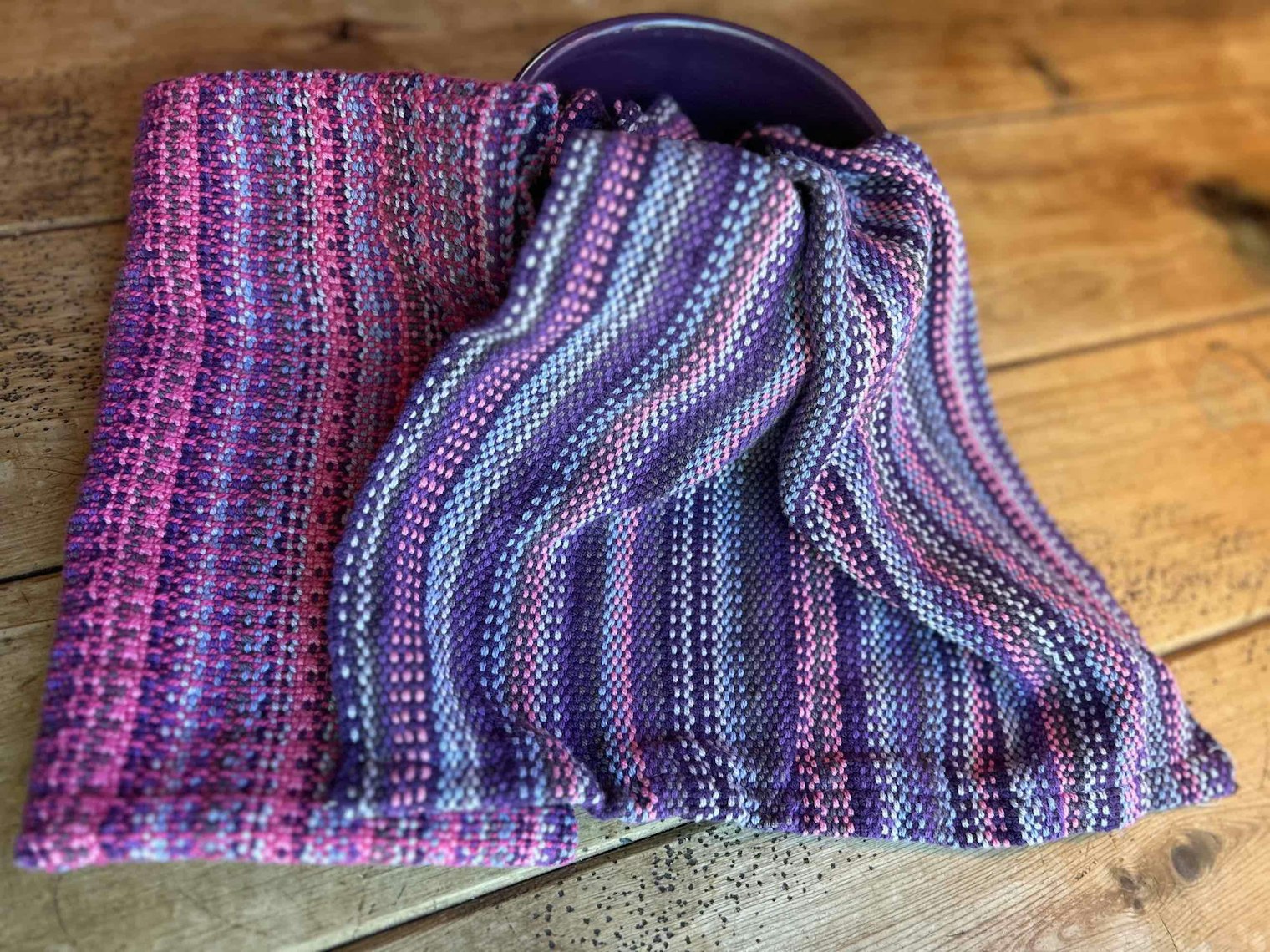
A few weeks ago, while looking at the Summer 2025 “Shifting Colors” issue, I got a bout of inspiration: I had an image of a set of rigid-heddle-woven towels warped randomly with a variety of purples and maybe an accent of pink or turquoise, weft to be determined. The urge to weave those towels was so strong, I started the towels that evening. I grabbed a selection of purples and one bright pink in 8/2 cotton and got to work.
Before I go too far, I want to say that when it comes to experimenting, I can’t think of a better project than a towel. Why weave a sampler that will languish in the dark when I can weave a set of towels instead? If the experiment works, I have a beautiful set of towels I can hang on my oven with pride. If it doesn’t work the way I hope, I have a not-so-beautiful set of towels that will work just as well cleaning up messes. It’s a win-win situation!
I began direct warping the 8/2 cotton doubled in a 12-dent reed, pulling loops of thread through each slot and hole. However, I soon realized that random warping was much, much harder than I had imagined. For about 10 minutes I attempted random color changes, frequently pulling out all the yarn and starting over. Eventually I realized I needed rules for my “random” warping.
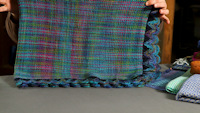
 Christina’s first Rule of Three towel partway through weaving.
That’s how I came up with what I called my “rule of three”: I would only sley three ends of one color before I switched to the next, and I would skip one slot or hole before starting the next color. For example, for my first six ends I threaded in this order: Color A in a hole, Color A in a slot, Color B in a hole, Color A in a slot, Color B in a hole, Color B in a slot or more simply, A, A, B, A, B, B. As I changed colors, I tried to do so randomly by mixing up the cones, closing my eyes, and picking up the first cone I touched, but I also gave myself the power to veto and pick a new color. Also, if I spaced off during warping and accidentally threaded it wrong, I didn’t worry—I figure any “errors” only added to the random feel of the piece.
As I warped, one of the first things I noticed was that some of the purples seemed to change colors when placed next to the more vibrant violets. For example, the perwinkle turned blue while the lilacs turned silver and gray. Rather than be discouraged, I found the changes fascinating and kept on warping. Because I was working with six colors, I had to cut and tie on the warp after each set of three, and even with direct warping this took a couple of hours. Once I’d warped from one end of the heddle to the other, it came time to pick a weft. After sampling five different options and doing an informal online poll, I settled on doubled violet 8/2 cotton for my first towel and a delightful Barbie pink in 3/2 cotton for the second.
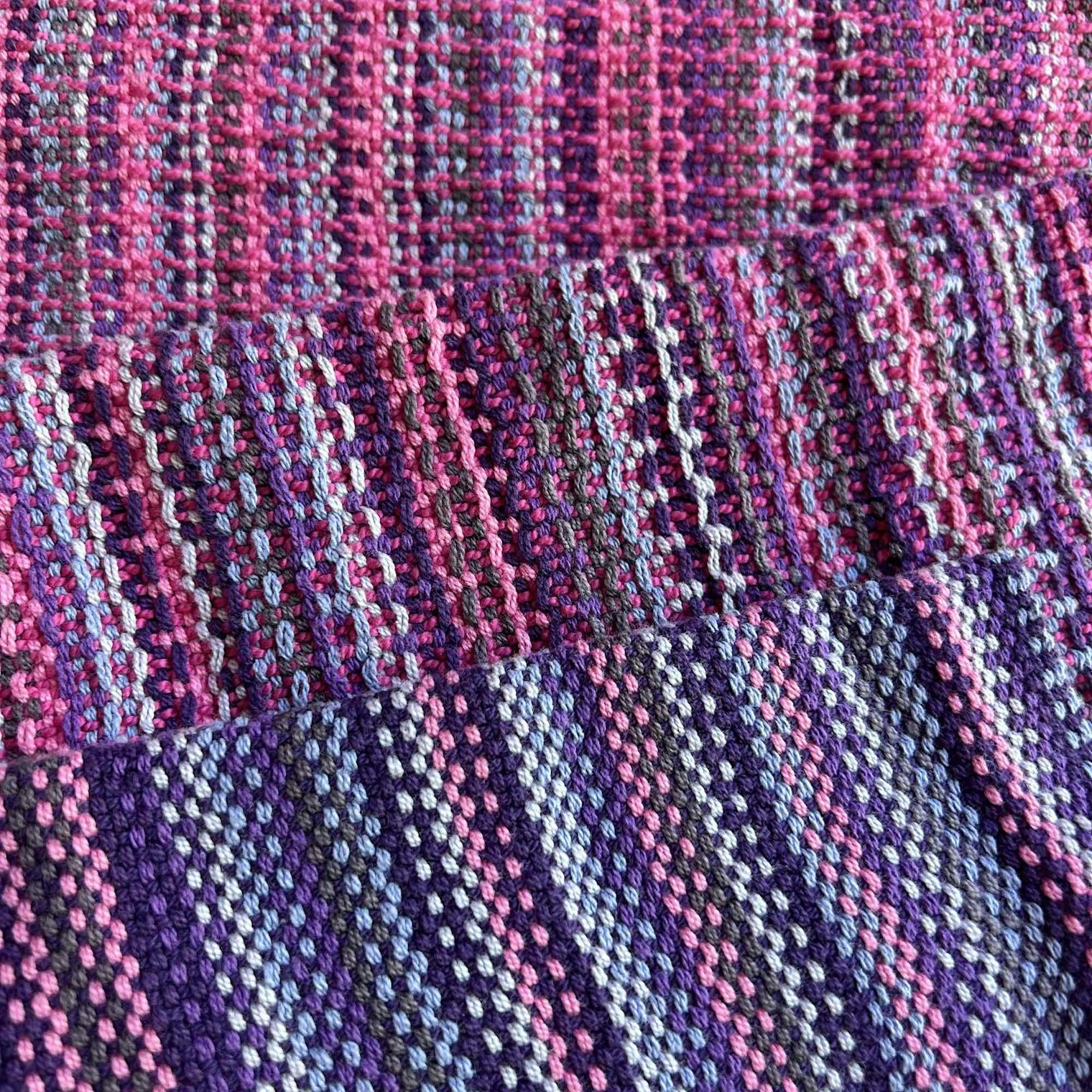 From top to bottom: Waffle towel with weft floats facing up, waffle towel with warp floats facing up, and plain weave towel.
I wove the first towel in plain weave and loved the way it highlighted the stripes in the warp, but as I was weaving, I wondered what would happen if I wove the second towel in a waffle weave? So that’s exactly what I did, and I ended up loving the second towel even more. While the waffle didn’t end up waffling all that much after wet-finishing, the texture it has is wonderful—and I honestly cannot tell you which side I like better! Looking at the two towels side by side I’m amazed at how such a small change—weft color and a bit of pick-up—made such a huge difference in the aesthetics.
My Rule of Three Towels were an adventure to warp and a delight to weave. While my brain has now been pulled in a new direction (Baltic pick-up on the inkle loom!), I know it will only be a matter of time before I’ll want to try out this method with a new color scheme and make myself a new set of almost randomly warped towels.
Happy Weaving!
Christina
More from Little Looms
 Skill Guide: A Weaver’s Guide to FiberNo matter what loom(s) you love to weave on, understanding the different characteristics of a fiber can help you make better choices when picking yarns for projects.Christina Garton · July 31, 2026
 From WIF to Woven ClothLearn how to use WIFs and weaving software to create and edit patterns—before you put a single thread on the loom. Christina Garton · July 23, 2026
 Give Yourself the Gift of a Weaving GetawayWhat’s better than learning to master a new weaving? Doing it among friends, new and old! Little Looms Editors · July 21, 2026
 6 Easy Ways to Elevate Your Selvedges with TrimsAdd extra flair to your selvedges and hems with these terrific trims. Christina Garton · July 16, 2026
 Twill for the Rigid-Heddle Loom: It’s Easier Than You Think!Learn why weavers love twill—and what makes it a great weave for the rigid-heddle loom.Christina Garton · July 14, 2026
 A Celebration of Stripes: Call for Submissions Fall 2027We're looking for striped projects of all kinds for our Fall 2027 issue—and that includes plaids and checks, too!Christina Garton · July 9, 2026
 Make Your Own Cardboard Mini-ShuttlesButterflies are beautiful, but they’re not always the best choice when you’re weaving. Try winding small bits of weft on these simple, DIY cardboard shuttles instead!Christina Garton · July 7, 2026
 A Trio of Table ToppersGo beyond rectangular runners with table toppers. Christina Garton · June 30, 2026
 Crochet for Your Selvedges? Your Edges Will Thank YouFind out why Sara Bixler finishes some of her woven pieces with crochet. Watch her free video clip, and then dive into several stitch options to try on your next project. Little Looms Editors · June 25, 2026
 Compose a Masterpiece on Your LoomAfter all, a loom is just another type of stringed instrument. Christina Garton · June 23, 2026
From the Library




Comments
No comments yet — be the first to share your thoughts.
Sign in to join the conversation — commenting is for signed-in members.