
Loading the latest stories…

Most rigid-heddle weavers start out with stick shuttles, but did you know that's not the only option for rigid-heddle weavers? Learn a bit more about the shuttle options available!
Christina Garton3 min read
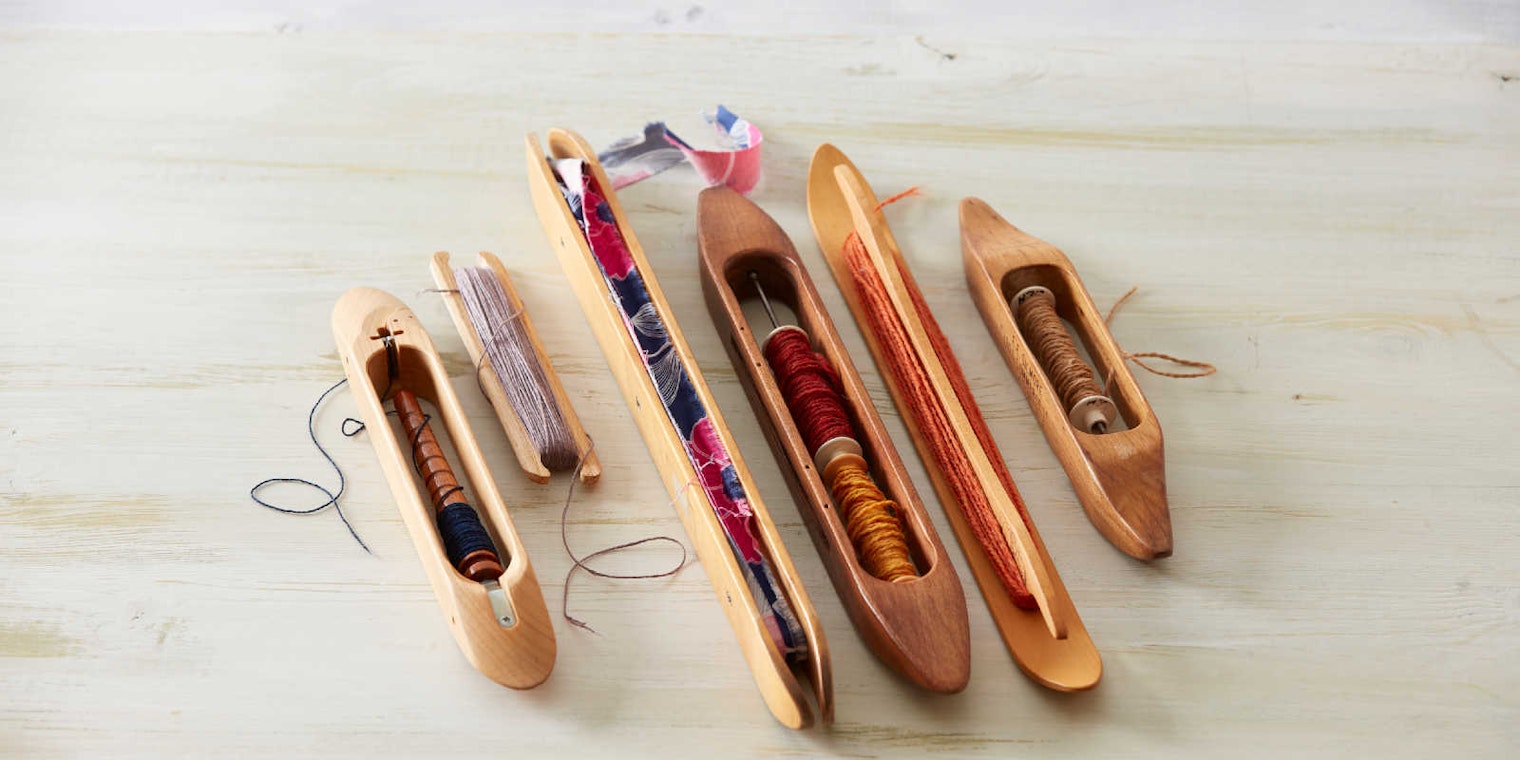
If you’re a rigid-heddle weaver, there’s a good chance you’re using a stick shuttle. Most new rigid-heddle looms come with one, they’re easy to pass through the shed, and they can also act as a pick-up stick or secondary beater in a pinch. But did you know there is a world of other shuttles available for the rigid-heddle loom if you’re in need of a change? As long as you make sure to pick a shuttle that’s narrow enough to fit in the shed of a rigid-heddle loom, you have lots of options! Here are a few alternative weft carriers available to rigid-heddle weavers and why you might want to use them.
Boat shuttles come in a variety of sizes, shapes, and styles. Photo by Matt Graves
I remember the first time I used a boat shuttle—I was absolutely flabbergasted at how easy they were to use. Unlike a sitck shuttle that must be unwound with ever weft pick or two, boat shuttles have a bobbin that will unspool as you weave, giving you just the right amount of yarn with every pick. While rigid-heddle looms don’t have shuttle races like multi-shaft looms, making it difficult to impossible to throw the shuttle across the warp, boat shuttles can hold more weft and unspool more efficiently, and they feel really nice in the hand. Boat shuttles come in different varieties, too: You can find open-bottom, closed-bottom, double-bobbin, and end-feed boat shuttles, the latter of which use quills instead of bobbins. Just make sure when winding a boat shuttle that you have something for winding bobbins or quills, whether that’s a traditional bobbin winder or an insert for an electric drill. Also, if you like to weave extra-wide cloth on the rigid-heddle loom, it might be harder to pass the shuttle from side to side.
If you like to weave with thick wefts, ski shuttles might be a good choice for you. True to their name, ski shuttles look like a ski but then have two “wings” on top for winding weft. Sometimes the wings connect and sometimes there’s a space between the wings. If there’s a space between the wings, you can wind your weft in a figure eight, which allows for even more yarn.
As you might be able to guess from the name, rag shuttles are designed to hold rags. Rag shuttles look at bit like two ski shuttles stuck together with a ski on either side and the weft-holding area between them. The space between the skis is usually wide enough so you can wind your rags without squishing or wrinkling them.
 The Ashford Wavy Stick is just one example of the wavy shuttles available. Photo courtesy of Ashford
While all the shuttles mentioned above are good for weaving your weft flat with the fell line, wavy shuttles are shaped to create a wavy or zigzag effect with each pick of weft. Using a wavy shuttle is a great way to get interesting patterns and textures into your weaving, but be careful—only some yarns work well with these shuttles. You need to weave with something that will stick to the warp; otherwise, all the waves will wash out when you wet-finish the cloth.
 Tapestry bobbins are great for inlay. Photo by Joe Coca
While tapestry bobbins are technically not shuttles, they are great for holding weft for inlay or other techniques that require small amounts of supplementary weft. The weft is wound around the handle and the pointed bit is used to pick through warp threads. So if you need only a bit of a specific yarn here and there for a pop of color and pattern, try a tapestry bobbin instead of the usual yarn butterfly.
So there you have it! Five different weft carriers that aren’t your typical stick shuttle for the rigid-heddle loom. What you’re weaving will determine which type of shuttle is right for you, and as I mentioned before, whatever shuttle you choose needs to be narrow enough to fit into the narrow shed of the rigid-heddle loom.
Happy Weaving!
Christina
More from Little Looms
 Tutorial: Continuous-Strand WeavingLearn the basics of using the continuous strand–weaving method on a pin loom.Jennifer Chapman · July 30, 2026
 Twill for the Rigid-Heddle Loom: It’s Easier Than You Think!Learn why weavers love twill—and what makes it a great weave for the rigid-heddle loom.Christina Garton · July 14, 2026
 Dealing with Selvedges that Go BumpLace weaves are notorious for creating uneven, scalloped, and overall lumpy-bumpy selvedges. Learn two different methods for handling these selvedges in the first installment of our Summer Selvedge Series. Christina Garton · June 4, 2026
 My New Obsession: Three-Color Pick-up on the Inke LoomFind out how this niche Lithuanian technique found its way to America, and why it’s Christina’s new favorite way to create patterns on her inkle loom.Christina Garton · May 5, 2026
 Long Thread Podcast: Angela Tong, Multidisciplinary MakerSeason 14, Episode 7: A jeweler, knitter, crocheter, weaver, and potter sit down for a chat—and it turns out she's the same person. Angela Tong talks about a creative life built on detail, technique, and staying true to her own voice.Anne Merrow · May 2, 2026
 Get Started: Read a Basic Rigid-Heddle PatternHere's what you'll see in a rigid-heddle pattern in Little Looms—and how to translate that information to the loom!Christina Garton · April 23, 2026
 Up Your Design Game with the Fibonacci SequenceLearn how easy it is to design beautiful, asymmetric patterns using a simple bit of math. Christine Jablonski · April 21, 2026
 Perfectly Portable Looms for Weaving on the GoInterested in weaving on small looms? Learn how easy it is to build your own tiny weaving studio and sampler looms using simple household items. Elizabeth Jensen · March 26, 2026
 Join the Band: A New Retreat Just for BandweaversJoin us this fall for four days of bandweaving fun at Band Camp for Weavers!Christina Garton · March 24, 2026
 Long Thread Podcast: Heather Torgenrud, Pick-Up BandweavingSeason 14, Episode 4: Although her weaving interests vary from Anne Merrow · March 21, 2026
From the Library


Comments
No comments yet — be the first to share your thoughts.
Sign in to join the conversation — commenting is for signed-in members.