
Loading the latest stories…

Weavers tend to think of squares and rectangles when designing, but what about other shapes, such as hexagons?
Gabi van Tassell4 min read

Here is the first of 3 posts about designing with hexagons by Gabi van Tassell, the owner of Turtle Looms and one of our favorite designers. —Susan
Hexagons are all around us, most notably in beehives, soap bubbles, snowflakes, turtle shells, carbon molecules. And did you know that the planet Saturn features a huge hexagon cloud over its north pole?
While nature has good reasons for using hexagons for optimizing space and strength, in fiber crafts we can use hexagons for fun and enjoy their mosaic inspiration. Pin-loom weaving comes in very handy when designing with hexagons. Hexagons weave up in little time and come off the loom ready to use. No elaborate need to cut fabric or templates, and you can quickly sample ideas.
Need some planning tools for hexagon projects? You can achieve very pretty results just by moving hexagons around until you like your design, but here are some basic hexagon-design concepts to help you go beyond that.
Hexagons have six sides and six angles, as the Greek word “hexágōnon” suggests. But you’d be surprised about all the shapes that you can make with six sides! In this first post, I’m going to focus on “regular” hexagons: six equal sides and six equal angles.
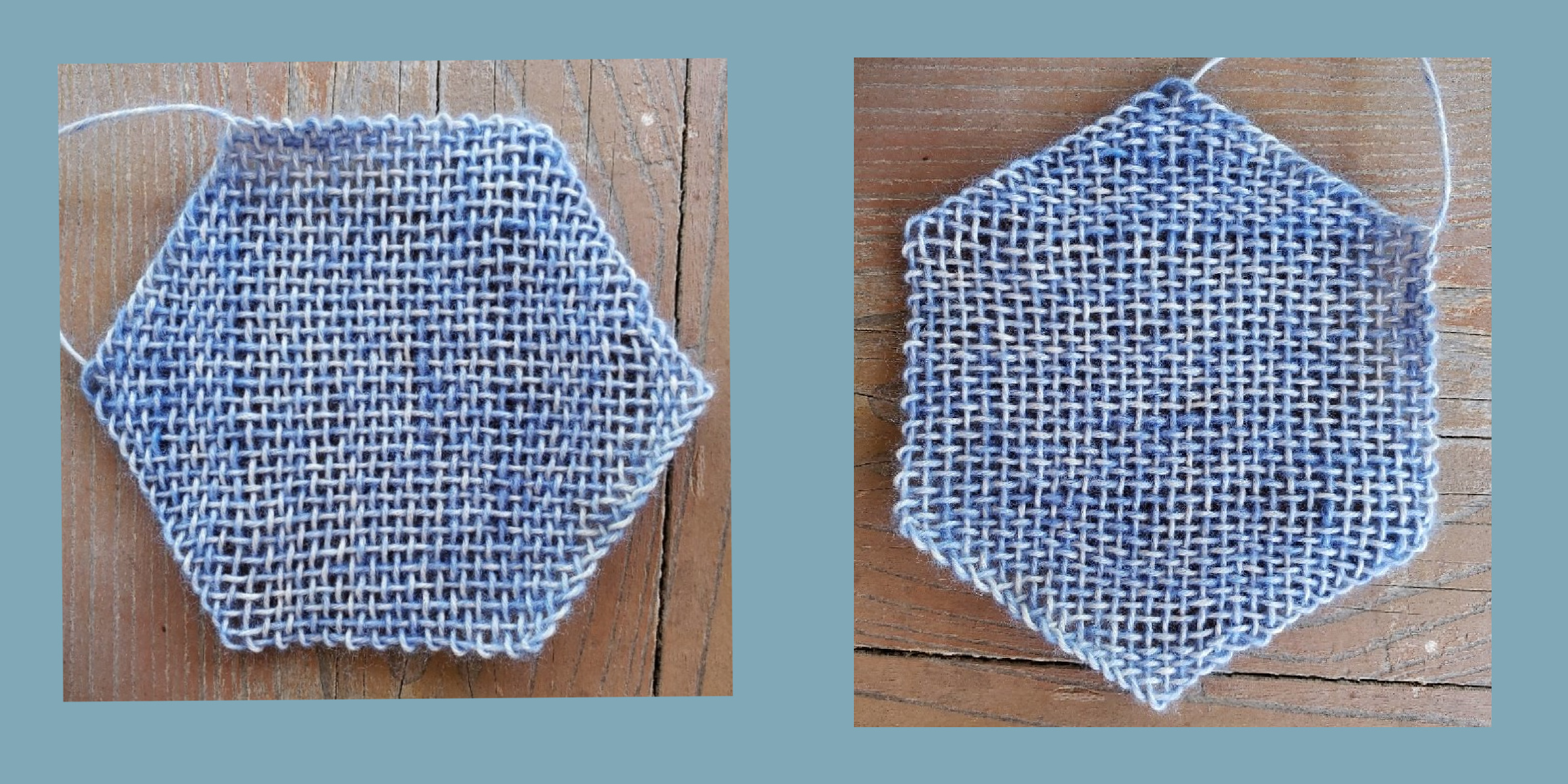
Line up, hexies! It is important to remember that hexagons are longer than they are wide. When you measure from tip-to-tip, you will get a longer measurement than when measuring side-to-side. Depending on how you lay out your hexagons, this will affect your design.

The example above shows how orientation affects a design. These hearts use almost the same number of hexagons (12 versus 13), but the appearance is very different. That is because in the design on the left, the tips run horizontally, and in the design on the right, the tips run vertically.
Start designing! Download these two blank design templates, one with a vertical and one with a horizontal orientation and explore hex design on your own.
If you prefer a nonpaper solution, you might try EQ7 (Electric Quilt 7 software), which I use for most of my designs. The software is not cheap, and hexagon designs are only a small fraction of the feature set, but in my opinion it is the best software solution right now.
Shape your project by varying the length of rows and the number of rows. Create a natural, free flowing shape as in the Indian Flower Blanket afghan featured in the top photo, or work regular increases and decreases to create a rectangle, a hexagon-of-hexagons, or a pointed or flat diamond.

Instead of lining up hexagons in rows, you can also start with a hexagon center and arrange rounds around that center. Using one or two rounds will result in an instant flower design such as shown on the left, or try one of the designs on the right as a jumping off point.
Fabric direction adds possibilities to designing with hexagons, and here is why. If you line up a square piece of fabric, the vertical warp and horizontal weft have little stretch, but there is stretch along their diagonals.
If you line-up a hexagon in the same way, you will have a mix of stretchy and non-stretchy sides.
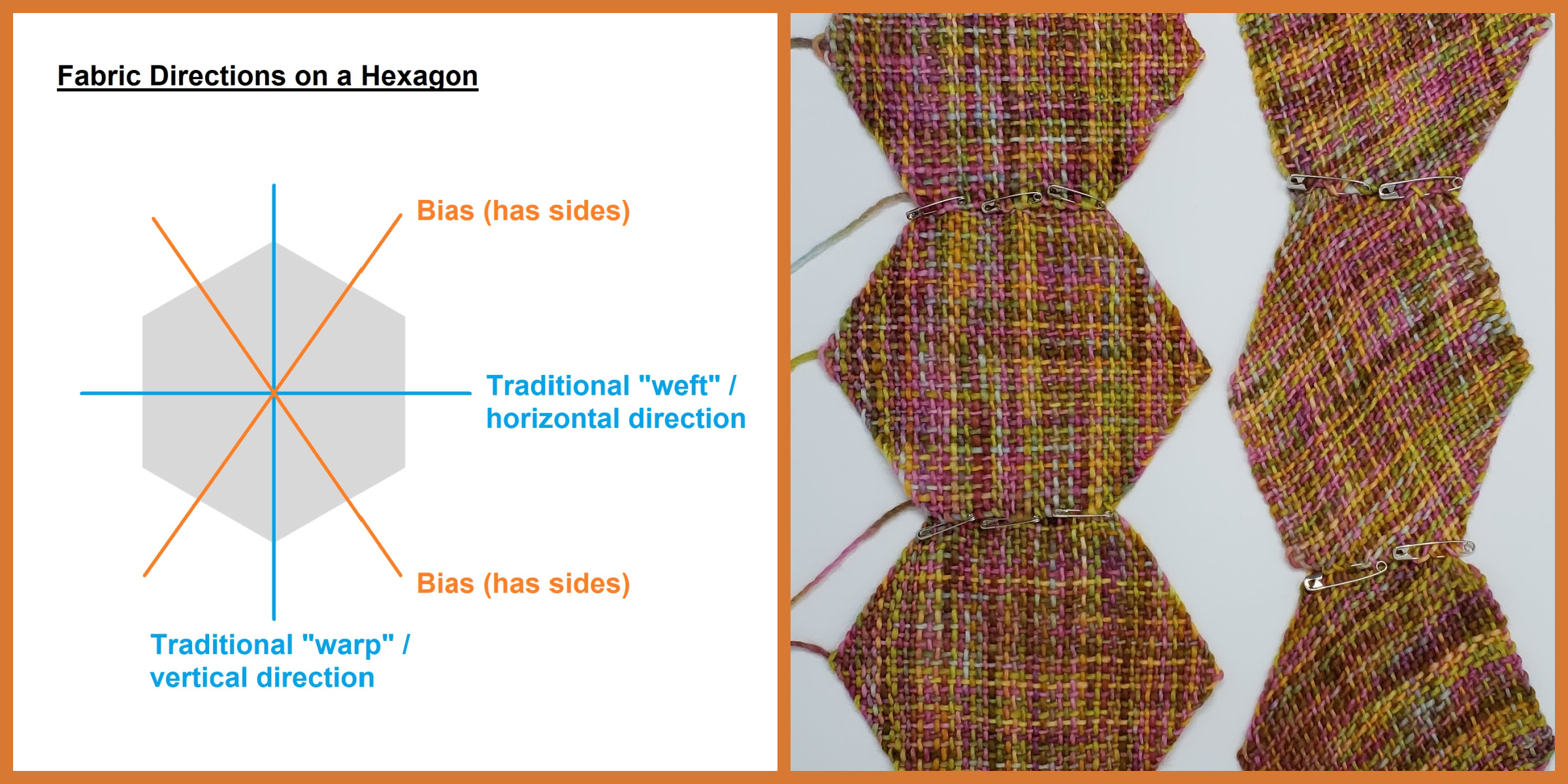
Use this property in your designs: Joining hexagons along the straight selvedges creates a fabric with little stretch, and the hexagon tips will stay intact as you can see in the strand on the left in the photo. A simple strand of hexagons joined in bias direction results in a stretchy fabric with smooth, wavy edgings as you can see on the right.
Arranging hexagons in random directions creates a fabric that is semistretchy and will bounce back into shape easily, a feature that comes in handy for some yarns with heavy drape or if you use a variety of very different yarns in the same project. Large projects assembled in that way benefit from maintaining an even shape.
I’m often asked where I get ideas for hexagon designs. I use Pinterest and other Internet resources for inspiration, and often multiple ideas (and yarns!) come together to make a design. Please always respect copyrights! Many patterns are free of charge and permit personal use. Check out the more than 3,000 hexagon pins on Pinterest board “Hexagon Crafts.”
Here is a list of keywords or topics to look for:
English Paper Piecing is a quilting method where often the tiniest pieces of fabric are turned into beautiful mosaic patterns. Even if you don’t make hexagons that small and projects that elaborate, you can use parts of such designs, for example a motif, a border solution, or even a certain use of colors or color arrangements.
Hexagon quilts and Grandmother’s Flower Garden quilts are another source of inspiration. As a matter of fact, it was the Great Depression heirloom quilt of my daughter’s weaving mentor Charlotte that influenced my desire to weave hexagons.
Granny crochet is a popular tradition of modular crocheting. Many of those designs use hexagons, and you can find some good construction ideas for bags and even garments.
Peyote and brick bead patterns. While beads are round, bead patterns are often depicted as hexagon charts for efficiency. Therefore, many bead patterns, for example for jewelry, can serve as inspiration. Make sure that the designs are laid out in a “brick” or peyote style, where the rows are offset.
Tile flooring. I’ve always been fascinated by pretty tile flooring patterns. Many of them use hexagon shapes, and you can find designs from historical and playful to contemporary and geometric. Again, often just a part of a pattern is enough to inspire a new project.
There are probably a million more things I could say about 2-dimensional designs using hexagons, but for now, the rest is up to you. In my next post, I’ll explain concepts of 3-dimensional designs. If you have questions or comments about designing with hexagons, please send them to handwoven@longthreadmedia.com. In the meantime, have fun playing with hexies!
More from Little Looms
 Tutorial: Continuous-Strand WeavingLearn the basics of using the continuous strand–weaving method on a pin loom.Jennifer Chapman · July 30, 2026
 Twill for the Rigid-Heddle Loom: It’s Easier Than You Think!Learn why weavers love twill—and what makes it a great weave for the rigid-heddle loom.Christina Garton · July 14, 2026
 Dealing with Selvedges that Go BumpLace weaves are notorious for creating uneven, scalloped, and overall lumpy-bumpy selvedges. Learn two different methods for handling these selvedges in the first installment of our Summer Selvedge Series. Christina Garton · June 4, 2026
 My New Obsession: Three-Color Pick-up on the Inke LoomFind out how this niche Lithuanian technique found its way to America, and why it’s Christina’s new favorite way to create patterns on her inkle loom.Christina Garton · May 5, 2026
 Long Thread Podcast: Angela Tong, Multidisciplinary MakerSeason 14, Episode 7: A jeweler, knitter, crocheter, weaver, and potter sit down for a chat—and it turns out she's the same person. Angela Tong talks about a creative life built on detail, technique, and staying true to her own voice.Anne Merrow · May 2, 2026
 Get Started: Read a Basic Rigid-Heddle PatternHere's what you'll see in a rigid-heddle pattern in Little Looms—and how to translate that information to the loom!Christina Garton · April 23, 2026
 Up Your Design Game with the Fibonacci SequenceLearn how easy it is to design beautiful, asymmetric patterns using a simple bit of math. Christine Jablonski · April 21, 2026
 Perfectly Portable Looms for Weaving on the GoInterested in weaving on small looms? Learn how easy it is to build your own tiny weaving studio and sampler looms using simple household items. Elizabeth Jensen · March 26, 2026
 Join the Band: A New Retreat Just for BandweaversJoin us this fall for four days of bandweaving fun at Band Camp for Weavers!Christina Garton · March 24, 2026
 Long Thread Podcast: Heather Torgenrud, Pick-Up BandweavingSeason 14, Episode 4: Although her weaving interests vary from Anne Merrow · March 21, 2026
From the Library




Comments
No comments yet — be the first to share your thoughts.
Sign in to join the conversation — commenting is for signed-in members.