
Loading the latest stories…

Esther Rodgers uses hand-manipulation techniques, interesting yarns, and a no-mistakes attitude to create her one-of-a-kind work. Allison explores Esther's philosophy of design in rigid-heddle weaving.
Allison Korleski2 min read
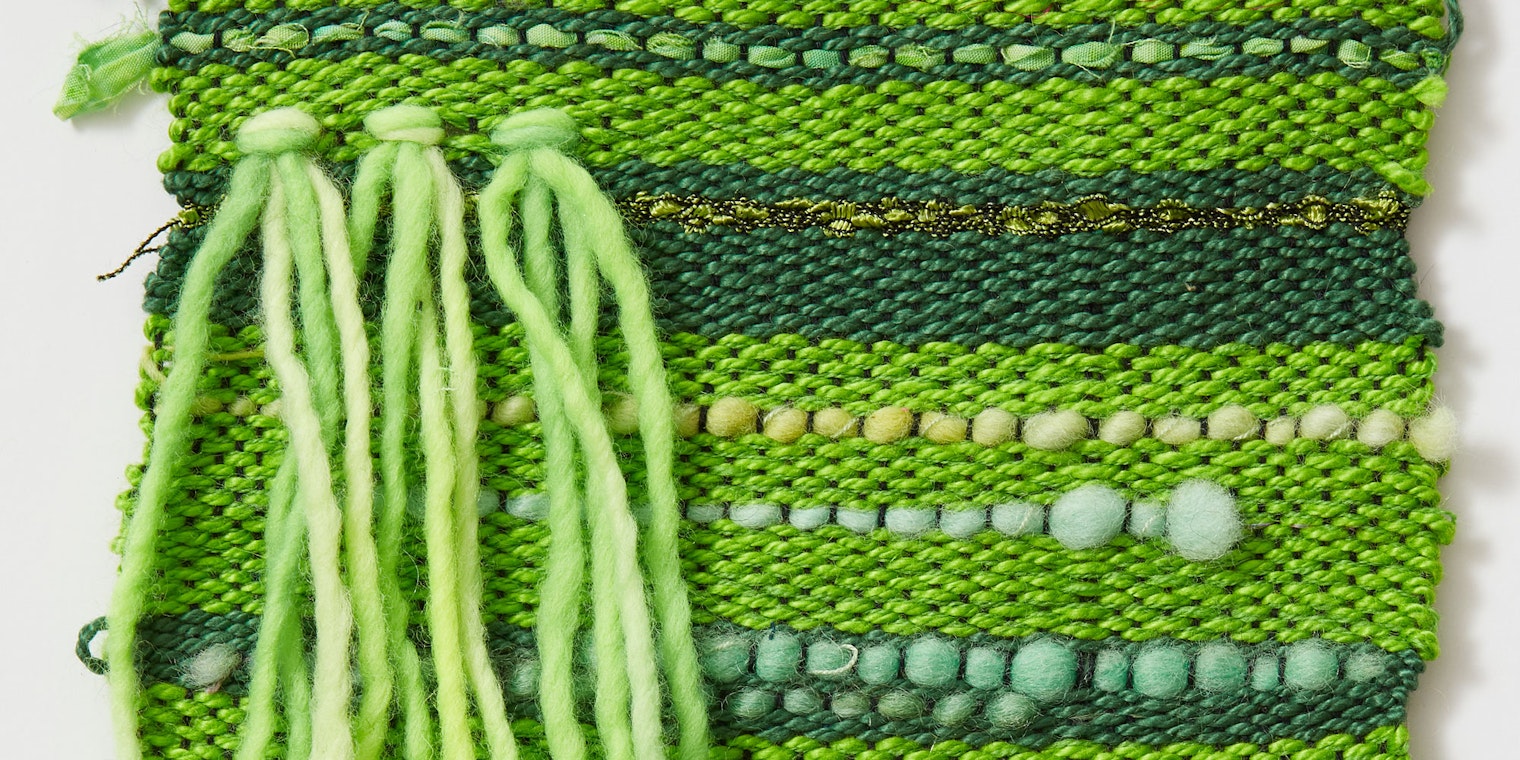
A few years ago I received a rigid-heddle loom. Excited, I immediately set it up, followed the warping instructions, and wove . . . an oblong. I wove a scarf and several little mug rugs on my new loom, but I was basically making multiple oblongs in plain weave. I felt uninspired and soon moved on to other things.
Flash forward to this summer, when I met weaver, spinner, and fiber artist Esther Rodgers. If anyone embodies the words passion and exuberance in her craft, it’s Esther. Her course Expressive Weaving on a Rigid-Heddle Loom is the one that really inspired me to look at my loom in a new light. Below are a few takeaways.
Esther likes to point out again and again that there are no “mistakes” in weaving, only opportunities. Have you ever skipped a thread in your warp and fretted over fixing it? Why not embrace that “error” and even repeat it deliberately several times? Skipping holes or slots, or cramming extra threads in a slot or hole, breaks up your warp pattern and adds subtle visual interest.
Adding or mixing wildly different materials in supplemental warp threads can make an even stronger statement. Change up the color, weight, or texture, and things get interesting really quickly. And it’s a good way to “fix” some of your skipped holes or slots, should you so desire.

Combining textures and yarn weights in rigid-heddle weaving—even in the warp!—makes for expressive texture. Photo by George Boe
There are tons of simple ways to liven up plain weave. Have some wild art yarn? While it can overwhelm, small quantities of art yarn add texture and color to your weft when used as inlay or side fringes. Same goes for sparkly or sequined novelty yarns. Or use up partial skeins to add contrasting colors, or change up the texture and hand of your fabric. Really, anything goes here.

Just a few yards of precious yarn, such as this handspun art yarn, can add a lot of pizzazz to rigid-heddle weaving. Photo by George Boe
There are a lot of tapestry-inspired techniques that are right at home on your rigid heddle. Loops, rya, and fringe are simple and fabulous ways to add texture to your piece, whether it’s for a wall hanging, a pillow, or a bag.
Clasped weft techniques really opened my eyes. Two shuttles, one simple technique, amazing results. You’ll be shocked—shocked, I say—to discover how a colorfully complicated-looking fabric is really beginner-level simple.
Expressive Weaving on a Rigid-Heddle Loom is a streamable course you can watch at your own pace, anywhere, anytime, on any device.
Happy watching! Allison
More from Little Looms
 Tutorial: Continuous-Strand WeavingLearn the basics of using the continuous strand–weaving method on a pin loom.Jennifer Chapman · July 30, 2026
 Twill for the Rigid-Heddle Loom: It’s Easier Than You Think!Learn why weavers love twill—and what makes it a great weave for the rigid-heddle loom.Christina Garton · July 14, 2026
 Dealing with Selvedges that Go BumpLace weaves are notorious for creating uneven, scalloped, and overall lumpy-bumpy selvedges. Learn two different methods for handling these selvedges in the first installment of our Summer Selvedge Series. Christina Garton · June 4, 2026
 My New Obsession: Three-Color Pick-up on the Inke LoomFind out how this niche Lithuanian technique found its way to America, and why it’s Christina’s new favorite way to create patterns on her inkle loom.Christina Garton · May 5, 2026
 Long Thread Podcast: Angela Tong, Multidisciplinary MakerSeason 14, Episode 7: A jeweler, knitter, crocheter, weaver, and potter sit down for a chat—and it turns out she's the same person. Angela Tong talks about a creative life built on detail, technique, and staying true to her own voice.Anne Merrow · May 2, 2026
 Get Started: Read a Basic Rigid-Heddle PatternHere's what you'll see in a rigid-heddle pattern in Little Looms—and how to translate that information to the loom!Christina Garton · April 23, 2026
 Up Your Design Game with the Fibonacci SequenceLearn how easy it is to design beautiful, asymmetric patterns using a simple bit of math. Christine Jablonski · April 21, 2026
 Perfectly Portable Looms for Weaving on the GoInterested in weaving on small looms? Learn how easy it is to build your own tiny weaving studio and sampler looms using simple household items. Elizabeth Jensen · March 26, 2026
 Join the Band: A New Retreat Just for BandweaversJoin us this fall for four days of bandweaving fun at Band Camp for Weavers!Christina Garton · March 24, 2026
 Long Thread Podcast: Heather Torgenrud, Pick-Up BandweavingSeason 14, Episode 4: Although her weaving interests vary from Anne Merrow · March 21, 2026
From the Library


Comments
No comments yet — be the first to share your thoughts.
Sign in to join the conversation — commenting is for signed-in members.