
Loading the latest stories…

Whether you’re weaving traditional-style tapestries or textured art pieces, there are a few weaving tapestry tools that will make your life easier.
Handwoven Editors2 min read
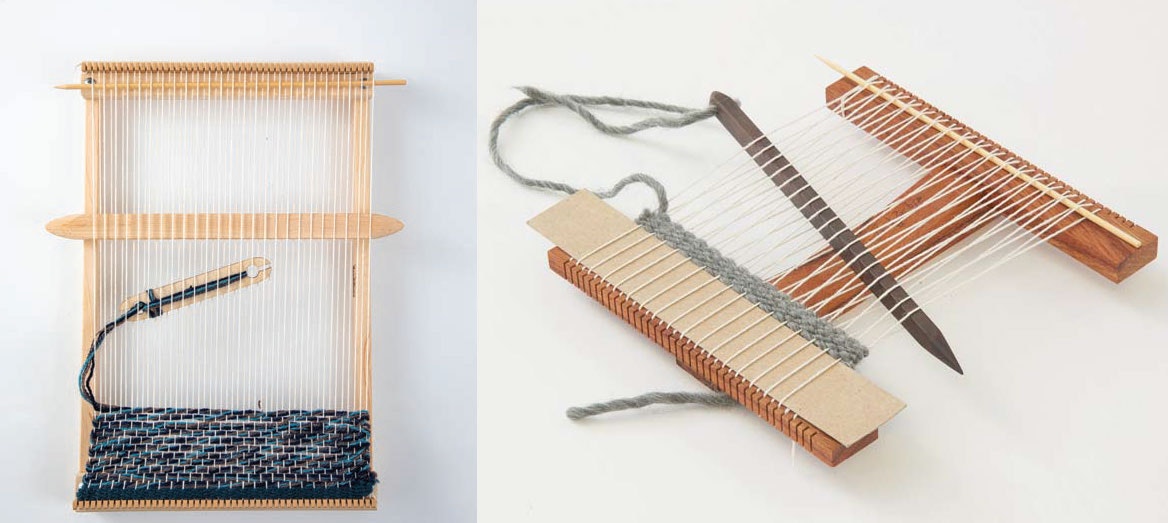
I don't know what it is about summer, but it always makes me feel like weaving tapestry. I think it's because I can take my tiny I-Loom with me outside where I can weave as I watch my children play. Maybe it's because it's so easy to incorporate natural found objects into tapestry pieces. Whatever it is, I certainly have tapestry on the mind, and I'm sure I'm not the only one. So what better time than summer to go over the basics of what you need to get started weaving tapestry.
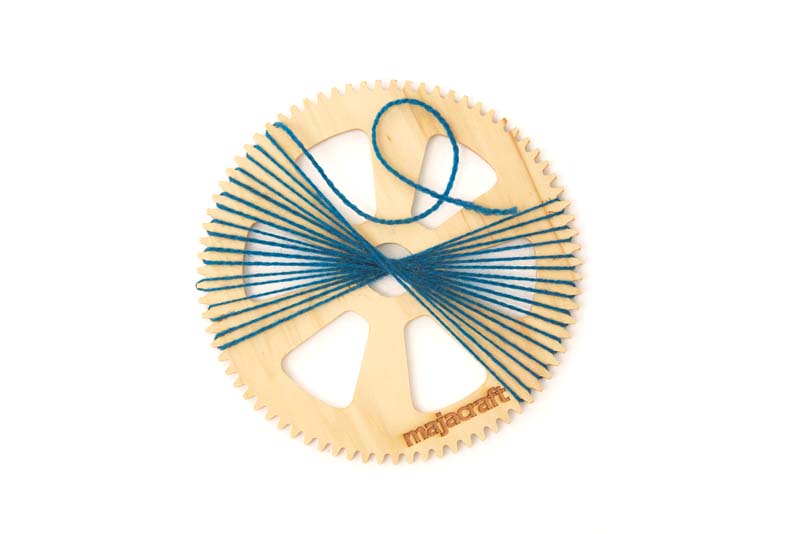
Looms used for simple tapestry are the most basic of tools, just enough to hold the warp evenly spaced and under tension for your creative endeavors. For the pieces demonstrated here, a frame loom or lap loom will do the trick. Some tapestry looms have another element, a mechanism for holding heddles and a shed. Another fun option is a circular loom, which holds the warp threads in a radiating pattern.
Depending on your yarn and the width of your warp, you may be able to use a typical tapestry needle or longer weaving needle to pass the weft.

Weaving needle Photo credit: Geoege Boe
A smooth piece of wood longer than the width of your warp, this will hold one of the weaving sheds open, making half of the weft passes a cinch. Most weavers use a pick-up stick for this purpose.
Although you could use a needle to place each pick, the short lengths of yarn involved can make for a lot of ends to weave in. A shuttle will hold more yarn and be easier to pass through the warp.
Majacraft Circular Loom 7" (available from The Woolery)
More from Little Looms From the LibraryKeep reading and making
 Tutorial: Continuous-Strand WeavingLearn the basics of using the continuous strand–weaving method on a pin loom.Jennifer Chapman · July 30, 2026Twill for the Rigid-Heddle Loom: It’s Easier Than You Think!Learn why weavers love twill—and what makes it a great weave for the rigid-heddle loom.Christina Garton · July 14, 2026Dealing with Selvedges that Go BumpLace weaves are notorious for creating uneven, scalloped, and overall lumpy-bumpy selvedges. Learn two different methods for handling these selvedges in the first installment of our Summer Selvedge Series. Christina Garton · June 4, 2026My New Obsession: Three-Color Pick-up on the Inke LoomFind out how this niche Lithuanian technique found its way to America, and why it’s Christina’s new favorite way to create patterns on her inkle loom.Christina Garton · May 5, 2026Long Thread Podcast: Angela Tong, Multidisciplinary MakerSeason 14, Episode 7: A jeweler, knitter, crocheter, weaver, and potter sit down for a chat—and it turns out she's the same person. Angela Tong talks about a creative life built on detail, technique, and staying true to her own voice.Anne Merrow · May 2, 2026Get Started: Read a Basic Rigid-Heddle PatternHere's what you'll see in a rigid-heddle pattern in Little Looms—and how to translate that information to the loom!Christina Garton · April 23, 2026Up Your Design Game with the Fibonacci SequenceLearn how easy it is to design beautiful, asymmetric patterns using a simple bit of math. Christine Jablonski · April 21, 2026Perfectly Portable Looms for Weaving on the GoInterested in weaving on small looms? Learn how easy it is to build your own tiny weaving studio and sampler looms using simple household items. Elizabeth Jensen · March 26, 2026Join the Band: A New Retreat Just for BandweaversJoin us this fall for four days of bandweaving fun at Band Camp for Weavers!Christina Garton · March 24, 2026Long Thread Podcast: Heather Torgenrud, Pick-Up BandweavingSeason 14, Episode 4: Although her weaving interests vary from Anne Merrow · March 21, 2026Chart/IllustrationGraph Paper for Weavers
Comments
No comments yet — be the first to share your thoughts.
Sign in to join the conversation — commenting is for signed-in members.