
Loading the latest stories…

Whether you’re weaving for a holiday, as a gift, or just because, having the right-sized napkin for the job makes all the difference.
Christina Garton4 min read
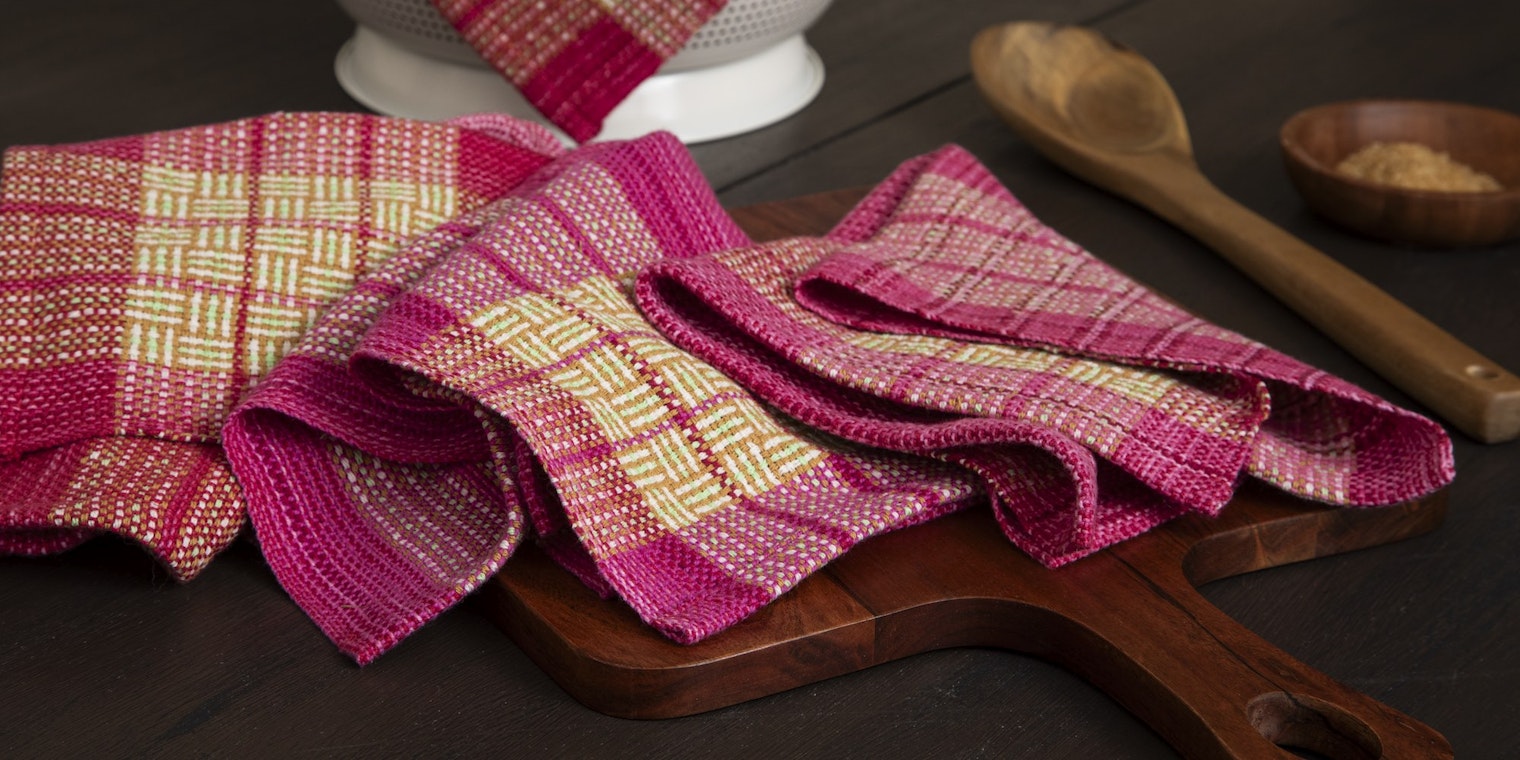
What size napkin is the best size to weave? That answer is (as with many weaving questions) “it depends.” How wide is your loom? Do you want to weave more than just napkins on the same warp? Who is the intended recipient of the napkins, and what is their purpose? Are these everyday napkins, or will they be for a special dinner?
While there isn’t a Grand Napkin Council out there making decrees about napkins sizes (that we know of), there are a few accepted guidelines for napkin sizes. Generally speaking, the more formal the occasion, the larger the napkin, as you can see in the handy chart below. Why so many sizes? Napkins sizes are guided by use; read on to learn more about the different napkin types, what they’re used for, and, in some cases, project examples from Easy Weaving with Little Looms.
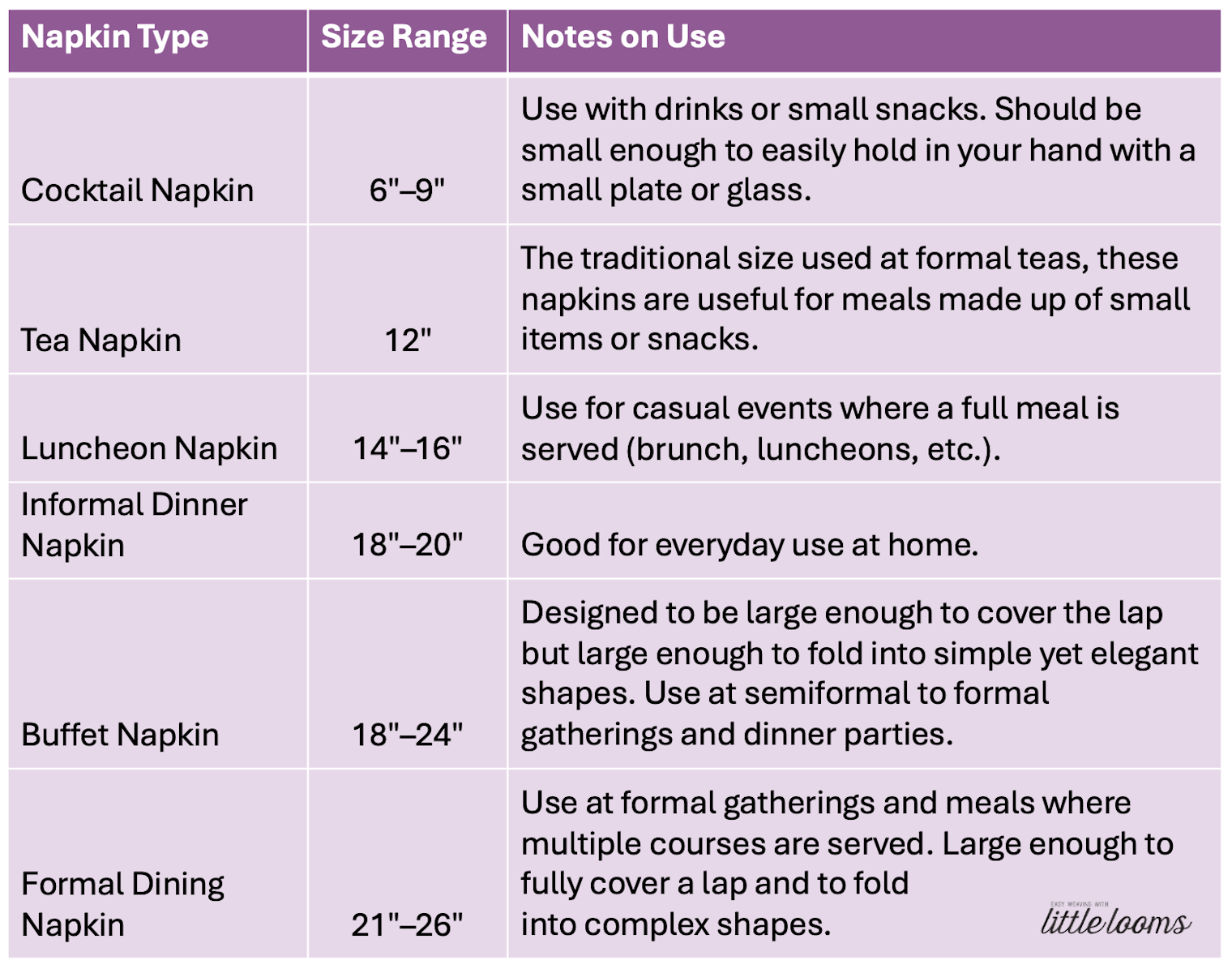
I like to break up the types of napkins into two categories. The first category, made up of the three smallest napkins, I call casual party napkins because these are the napkins you'd use in low-key get-togethers with small snacks, appetizers, and maybe a small meal that can be eaten while standing.
The smallest of these napkins is the cocktail napkin, which is the kind you’d have with a nosh board at a party. These need to be only 6 to 9 inches square—small enough to dab the mouth while chatting, but not so large that you can’t easily hold it in the same hand as your drink or plate.
Measuring in at 12 inches square, tea napkins are perfect for informal gatherings where you need something slighly more substantial than a cocktail napkin but still not so large that you can’t easily hold both the napkin and a plate. As the name suggests, these are the traditional size for tea, although they would work well for any event with messy appetizers or hors d'oeuvres eaten standing up. An example of this kind of napkin would be Yvonne Ellsworth’s Zakka Embroidered Napkins from the Holiday 2021 issue of Little Looms.
 Zakka Embroidered Napkins by Yvonne Ellsworth. Photo by Matt Graves
If you’re having an casual get-together with a sit-down meal component, consider a luncheon napkin. These 14- to 16-inch square napkins are just large enough to cover the lap with little to no overhang. They’re great for brunches, luncheons, and bridal or baby showers. Luncheon napkins are also the most popular size of napkin amongst designers of Little Looms projects. For example, Elisabeth Hill’s Snappy Napkins from the Summer 2021 issue of Little Looms and Malynda Allen’s Sweet Americana Linens from the Winter 2024 issue.
 Snappy Napkins by Elisabeth Hill from the Summer 2021 issue of Easy Weaving with Little Looms. Photo by Matt Graves
The second category of napkins, I’m calling dinner napkins, although you could use them for any meal you’d like. They’re the largest of the napkin sizes.
Informal dinner napkins are everyday napkins—the kind you’d have at home for family dinners. At 18 to 20 inches square, these napkins are just the right size to cover your lap and maybe fold into a simple rectangle or triange when setting the dinner table.
Next there’s the buffet napkin, which tends to be about 18 to 24 inches square, meaning there’s a bit of overlap with informal dinner napkins. Also referred to as “casual-dining” napkins, buffet napkins are designed to be large enough to not just fit the average-sized lap, but to fold into simple, elegant shapes—restaurants often use this size of cloth napkin. At 18 inches square, Susan E. Horton’s Striped Napkins with Pick-Up could be considered informal dinner or buffet napkins, making them a versatile project.
 Susan E. Horton's Striped Napkins with Pick-Up. Photo by Joe Coca
Finally we have formal dinner napkins, which come in at a whopping 21 to 26 inches square. These are the napkins you'd find at a formal, multicourse meal. Why so large? First of all, if you’re at a formal dinner, chances are you’re wearing nicer and probaly more expensive clothing, so you want a napkin that will not only protect your lap but have some overhang to protect more of your legs as well. Also, if a meal has multiple courses and, therefore, more opportunities to get your face dirty, a larger napkin provides a larger usable surface area—nobody wants to wipe their face with a soiled napkin. One more reason formal napkins tend to be so large has nothing to do with utility; in fact, it’s downright frivolous. Larger napkins allow you to fold them into interesting and complex shapes, so it makes sense that if you’re putting on a big showcase dinner, you’d want the big show-y napkins.
 Boldly Striped Napkins by Angela Tong from the Summer 2021 Easy Weaving with Little Looms. Photo by Matt Graves
Just remember: when you weave napkins, your preference matters more than any “official designation.” If you want to weave a rectangular napkin, go ahead! In fact, that’s what Angela Tong did with her Boldly Striped Napkins from the Summer 2021 Little Looms. Measuring 11 inches by 19 inches, these napkins also feature fringe, another nontraditional element, but are so bright and beautiful, I’d be happy to have them on my dining-room table any day.
Happy Weaving!
Christina
More from Little Looms
 Beach House Placemats and NapkinsBring the beach to your loom--minus the sand and hermit crabs--with these tranquil placemats and napkins from Jodi Ybarra. Jodi Ybarra · July 18, 2023
 Bonus Project! Striped Napkins with Pick-UpGet all the information you need to weave these gorgeous pastel napkins by Susan E. Horton on your rigid-heddle loom. They’re the perfect spring weaving project!Christina Garton · April 27, 2023
 I Had to “Get” Rigid-Heddle Looms to Appreciate Them.I’m not sure why some things that are obvious to others aren’t so obvious to me. Here’s what I learned about weaving on the rigid-heddle loom that surprised me but wasn’t surprising.Susan E. Horton · July 7, 2020
 Rigid-Heddle Looms for Everyone!There’s no doubt that rigid-heddle looms offer lots of opportunities for beginning weavers, and so does this issue. Anne Merrow · April 21, 2017
 Twill for the Rigid-Heddle Loom: It’s Easier Than You Think!Learn why weavers love twill—and what makes it a great weave for the rigid-heddle loom.Christina Garton · July 14, 2026
 A Celebration of Stripes: Call for Submissions Fall 2027We're looking for striped projects of all kinds for our Fall 2027 issue—and that includes plaids and checks, too!Christina Garton · July 9, 2026
 Make Your Own Cardboard Mini-ShuttlesButterflies are beautiful, but they’re not always the best choice when you’re weaving. Try winding small bits of weft on these simple, DIY cardboard shuttles instead!Christina Garton · July 7, 2026
 Designing Borders for Pick-Up BandsLearn tips and tricks for designing borders for your pick-up bands, from simple stripes to more complex color-and-weave designs. Christina Garton · July 2, 2026
 A Trio of Table ToppersGo beyond rectangular runners with table toppers. Christina Garton · June 30, 2026
 Crochet for Your Selvedges? Your Edges Will Thank YouFind out why Sara Bixler finishes some of her woven pieces with crochet. Watch her free video clip, and then dive into several stitch options to try on your next project. Little Looms Editors · June 25, 2026
From the Library




Comments
No comments yet — be the first to share your thoughts.
Sign in to join the conversation — commenting is for signed-in members.