
Loading the latest stories…

The key to using the Block Island Blend, and really any traditional weaving yarn to weave towels on the rigid-heddle loom, is to follow a few rules.
Christina Garton3 min read
Post sponsored by Halcyon Yarn
I’ve made no secret of the fact that I love to weave towels more than anything else. Scarves are wonderful, don’t get me wrong, and so are blankets, shawls, and the rest. They just don’t give me the feeling of joy and delight that I get every time I use one of my handwoven towels. For this reason, it was very important to me that we included some great towel projects in our 2017 issue of Easy Weaving with Little Looms.
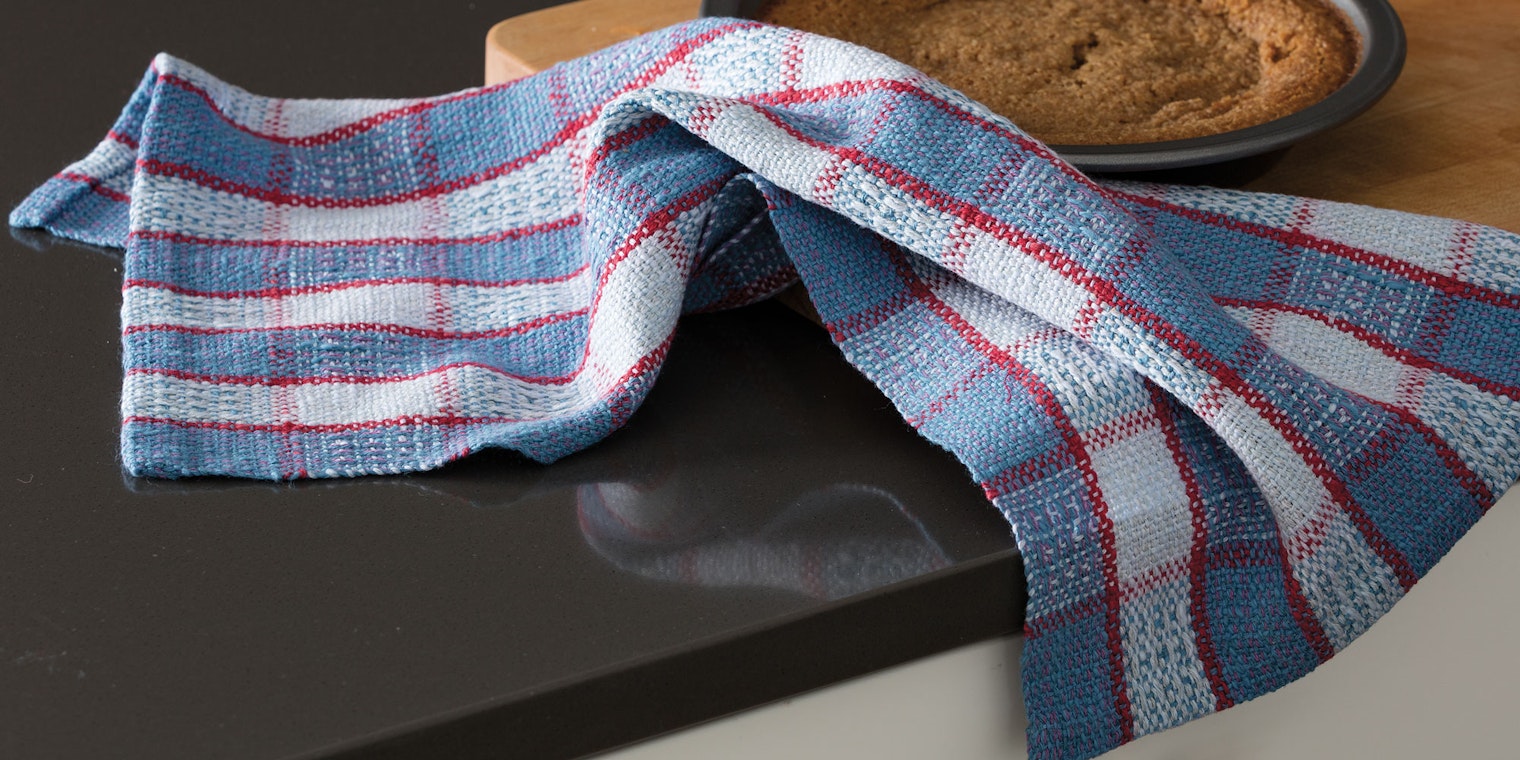
The first person I sought out to weave a set of towels for us was none other than the new editor of Handwoven, Susan Horton. I knew Susan was an expert at using traditional weaving yarns to make towels and napkins on the rigid-heddle loom and would be able to design us something wonderful. For her towels she used Halcyon Yarn’s Block Island Blend, a delightful yarn that blends slub cotton, either linen or hemp, and rayon. These three fibers work together to create a yarn that’s strong, absorbent, and durable with just the right amount of shine and texture. It’s the best of all three worlds!
Sett is always important, but with towels and napkins you need to make sure your sett is loose enough so the towel has some drape and the threads are far enough apart that they can expand as they absorb water. You also need to make sure that the sett is close enough that the threads don’t slide about or get caught when you try to clean with your towel. For the Block Island Blend, Halcyon Yarn recommends setting the yarn at 10 epi for plain weave while Susan chose to pair the yarn with Halcyon’s 8/2 Homestead Cotton and sett her towels at 12 epi.
Towels with textured weaves are not only more functional—many weavers claim the texture gives towels more absorbency—but they’re also beautiful. For her towels, Susan used a simple pick-up to give her towels something extra. The result is a look elegant and almost lacy looking. Just make sure whatever way you choose to add some texture to your piece that the floats aren’t too long.

Susan paired Halcyon Yarn’s Block Island Blend with Homestead 8/2 cotton and used a simple pick-up pattern to give the towels some texture and extra visual interest.
One of the best parts of weaving with yarns such as 8/2 cotton, 10/2 cotton, 22/2 cottolin, and the Block Island Blend is how well they work together. You can use more than one yarn in the warp like Susan did, or you can use one yarn as warp and another as weft. This will give you even more control over both your sett and drape. The Block Island Blend is great by itself, but pairing it with an 8/2 cotton like Susan did allowed her to use her 12-dent reed AND it allowed the unique texture and shine of the blend come to the forefront.
Traditional weaving yarns typically used for towels are great because they come in so many great colors! It’s almost too easy to keep a rainbow of yarns in your stash at all times. These yarns are perfect for playing with color, but do make sure you have enough room to sample just in case you need to modify your palette.
Speaking of sampling, to make sure your towels or napkins come out just right, make sure to put on enough warp so you can weave a sample, cut it off, and wet-finish it. Then, if you don’t like the colors or the sett doesn’t seem quite right you can simply adjust accordingly instead of having to start from scratch.
Weaving towels, napkins, and other kitchen linens on your rigid-heddle loom with traditional weaving yarns is so easy and fun. Plus there is just something so wonderful about pulling a handwoven towel out of your drawer or linen cupboard and thinking, “Hey! I made this useful thing!” If you’ve never woven towels on a rigid-heddle loom before, I hope these tips have inspired you to weave something wonderful!
Happy Weaving! Christina
More from Little Looms
 Tutorial: Continuous-Strand WeavingLearn the basics of using the continuous strand–weaving method on a pin loom.Jennifer Chapman · July 30, 2026
 Twill for the Rigid-Heddle Loom: It’s Easier Than You Think!Learn why weavers love twill—and what makes it a great weave for the rigid-heddle loom.Christina Garton · July 14, 2026
 Dealing with Selvedges that Go BumpLace weaves are notorious for creating uneven, scalloped, and overall lumpy-bumpy selvedges. Learn two different methods for handling these selvedges in the first installment of our Summer Selvedge Series. Christina Garton · June 4, 2026
 My New Obsession: Three-Color Pick-up on the Inke LoomFind out how this niche Lithuanian technique found its way to America, and why it’s Christina’s new favorite way to create patterns on her inkle loom.Christina Garton · May 5, 2026
 Long Thread Podcast: Angela Tong, Multidisciplinary MakerSeason 14, Episode 7: A jeweler, knitter, crocheter, weaver, and potter sit down for a chat—and it turns out she's the same person. Angela Tong talks about a creative life built on detail, technique, and staying true to her own voice.Anne Merrow · May 2, 2026
 Get Started: Read a Basic Rigid-Heddle PatternHere's what you'll see in a rigid-heddle pattern in Little Looms—and how to translate that information to the loom!Christina Garton · April 23, 2026
 Up Your Design Game with the Fibonacci SequenceLearn how easy it is to design beautiful, asymmetric patterns using a simple bit of math. Christine Jablonski · April 21, 2026
 Perfectly Portable Looms for Weaving on the GoInterested in weaving on small looms? Learn how easy it is to build your own tiny weaving studio and sampler looms using simple household items. Elizabeth Jensen · March 26, 2026
 Join the Band: A New Retreat Just for BandweaversJoin us this fall for four days of bandweaving fun at Band Camp for Weavers!Christina Garton · March 24, 2026
 Long Thread Podcast: Heather Torgenrud, Pick-Up BandweavingSeason 14, Episode 4: Although her weaving interests vary from Anne Merrow · March 21, 2026
From the Library


Comments
No comments yet — be the first to share your thoughts.
Sign in to join the conversation — commenting is for signed-in members.