
Loading the latest stories…


AA
What type of table runner is right for your table? Christina has tips for figuring out size, shape, and style.
Christina Garton3 min read
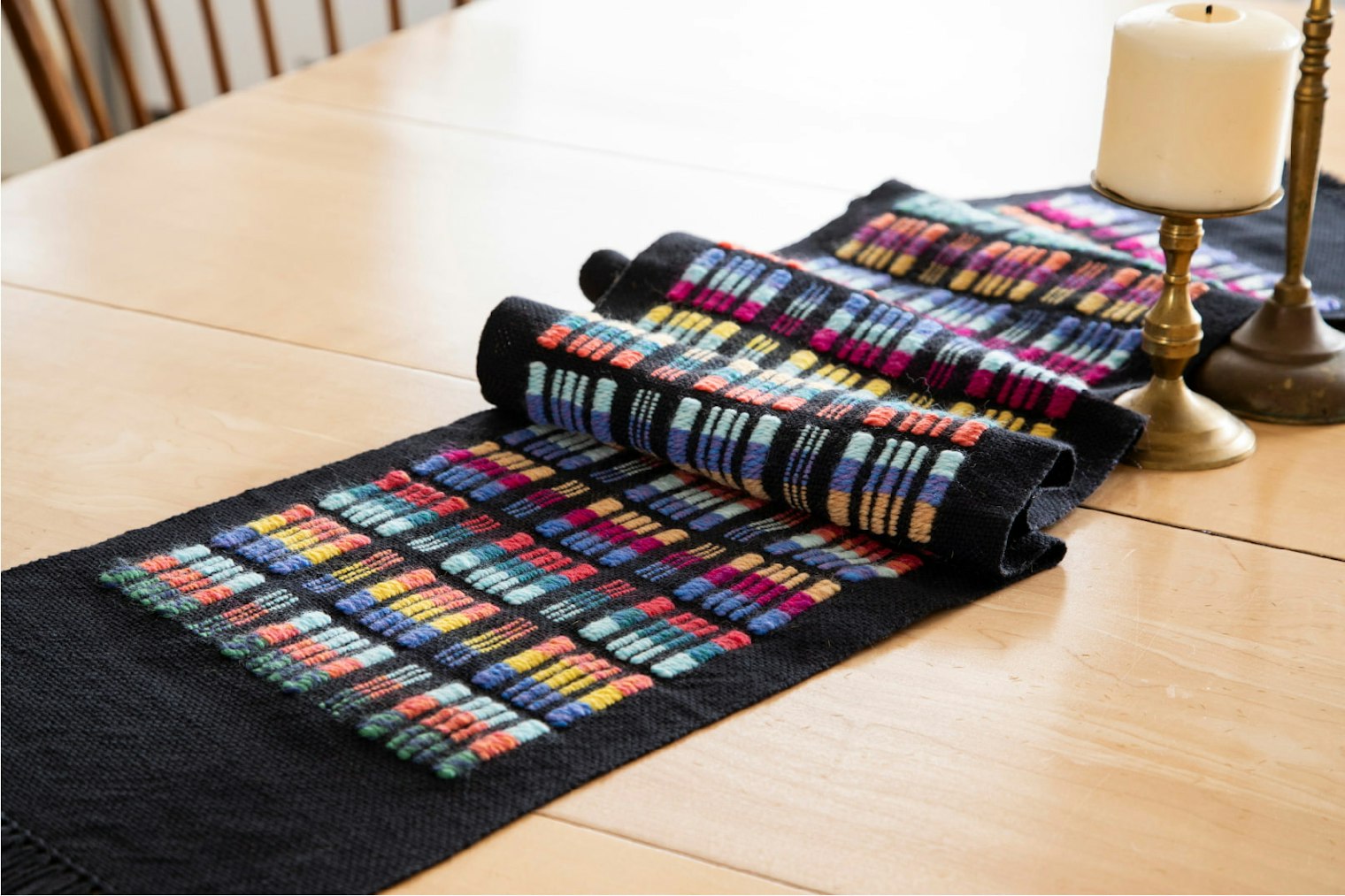
Let’s talk table runners. This perennially popular project type for weavers can be found in a variety of shapes and sizes—but how do you figure out which runner project is right for you?
Technically there are guidelines about what size of runner should go on what size table, depending on whether you want a centerpiece runner or one that has overhang. While these guidelines can help you figure out sizing, these are still just guidelines, not laws set in stone. The runner that’s best for you is the one that works for you.
 Gabi van Tassell's Queen Bee Table Topper would make a sweet addition to any table.
First, you need to decide what kind of runner you want to make: a standard runner or a “table topper.” The primary difference is that standard runners are rectangles and table toppers come in a variety of shapes and sizes. (Table toppers are probably more related to table doilies than runners, but we categorize them as runners in Little Looms.)
If you’re going to make a traditional rectangular runner, you’ll need to decide whether you want overhang or for the runner to float in the middle of the table. When making this decision, think about how people will sit around the table—would having overhang mean somebody would have runner in their lap? Then you need to think about size—not just the size of your table right now, but if your table has leaves that you use for special occasions, what’s the size of your table at its longest?
 The Snowy Owl Table Runner by Jenny Sennott cam be easily sized up or down to better fit your table.
The guideline for runners says if your runner sits in the middle of your table, it should be about two-thirds of the size of your table, and if you’re weaving one with overhang, it should have about 12"–18" of overhang. These measurement guidelines may or may not work for you depending on whether you use placemats on your table, how high your chairs are with the table, and whether you want a runner that will work with your leaves both in and out. I recommend making a muslin.
A muslin is a mock-up made with inexpensive fabric. Typically, muslins are used for sewing projects—especially clothing—to help make sure your item is properly sized before you sew with your nice fabric. Similarly, a muslin for a runner will help you figure out what size works best on your table—both length and width—before you start weaving. Fortunately, most, if not all, the standard runners we’ve printed in Easy Weaving with Little Looms can be adjusted to fit your table.
Now, table toppers are a completely different breed. They can be any shape or size and are part art piece, part practical table item. The main consideration for these is whether you’ll use them with placemats and, if so, whether the placemats will touch the table topper. Unlike traditional runners, table toppers don’t always size up or down nicely, so keep that in mind when choosing a project.
Yes, they’re called table runners and table toppers, but that doesn’t mean you’re limited to using them on your dining-room table. Runners look equally fabulous on coffee tables, buffets, credenzas, dressers, and nightstands. I bet you could even use one on the back of an upholstered chair to act as a sort of antimacassar. Just be aware: once you start looking around your house for new places to put weaving, it’s hard to stop.
Want some ideas for beautiful runners and table toppers you can weave up on your little loom? All Access Subscribers can click the links below to immediately download a PDF for each of the three projects shown above. If any of these projects aren’t for you, make sure to check out our Little Looms Library where you can filter your search by not just project and loom type but also by heddle width, sett, and pin loom shape(s) required.
Happy Weaving!
Christina
Gothic Table Runner by Jennifer Kwong
More from Little Looms
 Skill Guide: A Weaver’s Guide to FiberNo matter what loom(s) you love to weave on, understanding the different characteristics of a fiber can help you make better choices when picking yarns for projects.Christina Garton · July 31, 2026
 Tutorial: Continuous-Strand WeavingLearn the basics of using the continuous strand–weaving method on a pin loom.Jennifer Chapman · July 30, 2026
 Give Yourself the Gift of a Weaving GetawayWhat’s better than learning to master a new weaving? Doing it among friends, new and old! Little Looms Editors · July 21, 2026
 6 Easy Ways to Elevate Your Selvedges with TrimsAdd extra flair to your selvedges and hems with these terrific trims. Christina Garton · July 16, 2026
 A Celebration of Stripes: Call for Submissions Fall 2027We're looking for striped projects of all kinds for our Fall 2027 issue—and that includes plaids and checks, too!Christina Garton · July 9, 2026
 A Trio of Table ToppersGo beyond rectangular runners with table toppers. Christina Garton · June 30, 2026
 Crochet for Your Selvedges? Your Edges Will Thank YouFind out why Sara Bixler finishes some of her woven pieces with crochet. Watch her free video clip, and then dive into several stitch options to try on your next project. Little Looms Editors · June 25, 2026
 Compose a Masterpiece on Your LoomAfter all, a loom is just another type of stringed instrument. Christina Garton · June 23, 2026
 Two Ways to Make Terrific TasselsTurn loom waste or small bits of extra-special yarns into beautiful, custom-made tassels perfect for trimming handwoven projects and so much more!Christina Garton · June 18, 2026
 An Invitation to SparkleLearn three approaches for using metallic threads to weave fabric that literally shines bright! Christina Garton · June 16, 2026
From the Library


Comments
No comments yet — be the first to share your thoughts.
Sign in to join the conversation — commenting is for signed-in members.