
Loading the latest stories…

Looking for a loom to take with you when you travel? Consider giving tapestry a try!
Claudia Chase5 min read
You’re headed to an appointment and realize just as you grab your keys that you need a project to keep your hands busy in the likely case that you find yourself waiting. This project, this little savior, will let you pass the time in relative bliss. In fact, you might be so content working in the waiting room that you’re a little bit annoyed when your name is called. Such is the power of making: to lift you out of yourself and transport you to a land of bliss or a place that we call “flow.” Flow happens when time passes without you sensing it. You get so caught up in the flow when creating your art that time ceases.
You’ve probably entered that sacred space before. What medium did you use to get there? The image of a lady sitting on a bench waiting for a bus while clicking her knitting needles is an archetype of sorts. Maybe that archetype exists because people like us must make something, whether in public or in private, and really don’t care what anyone thinks about this compulsion. As a relative of ours once put in her epic needlepoint wall hanging: “Fish gotta swim, birds gotta fly . . . and I gotta make!” Okay, we added that last bit, but we swear that is what she was thinking when she made that stunning piece of her own design.

Small looms fit into your bag and make waiting times seem to magically shorten as you lose yourself in a tapestry project.
For us, our medium of choice, whether we’re curled up on the couch or sitting on a bus, is tapestry weaving. Tapestry is underrated as a portable craft. Its cousins knitting and crochet get a lot of attention as on-the-go activities, but tapestry holds its own as a movable hobby because it’s perfect for working on while traveling or simply out and about, as well as for those of us who need to keep our hands busy at all times.
Tapestry weaving is defined by three main elements: It is weft-faced, it is generally pictorial, and it is not woven entirely selvedge to selvedge with each pick. These three factors make it a relatively slow type of weaving. On the other hand, tapestry works very well on a portable loom, and here are a few reasons why. First, you can start and stop weaving relatively quickly. There is no need to finish a row or a section; you can weave one quick half-pass and stop if need be. Second, there’s not much cleanup. At home, you might weave with a basket of yarn by your side, but when you’re out and about, you can weave with a handful of premade butterflies that can be gathered up at a moment’s notice. Third, a quality tapestry can be woven at any scale. When you imagine tapestry weaving, you may picture enormous pieces covering castle walls, but with the right loom, you can make a gallery-ready piece that will fit in one hand.
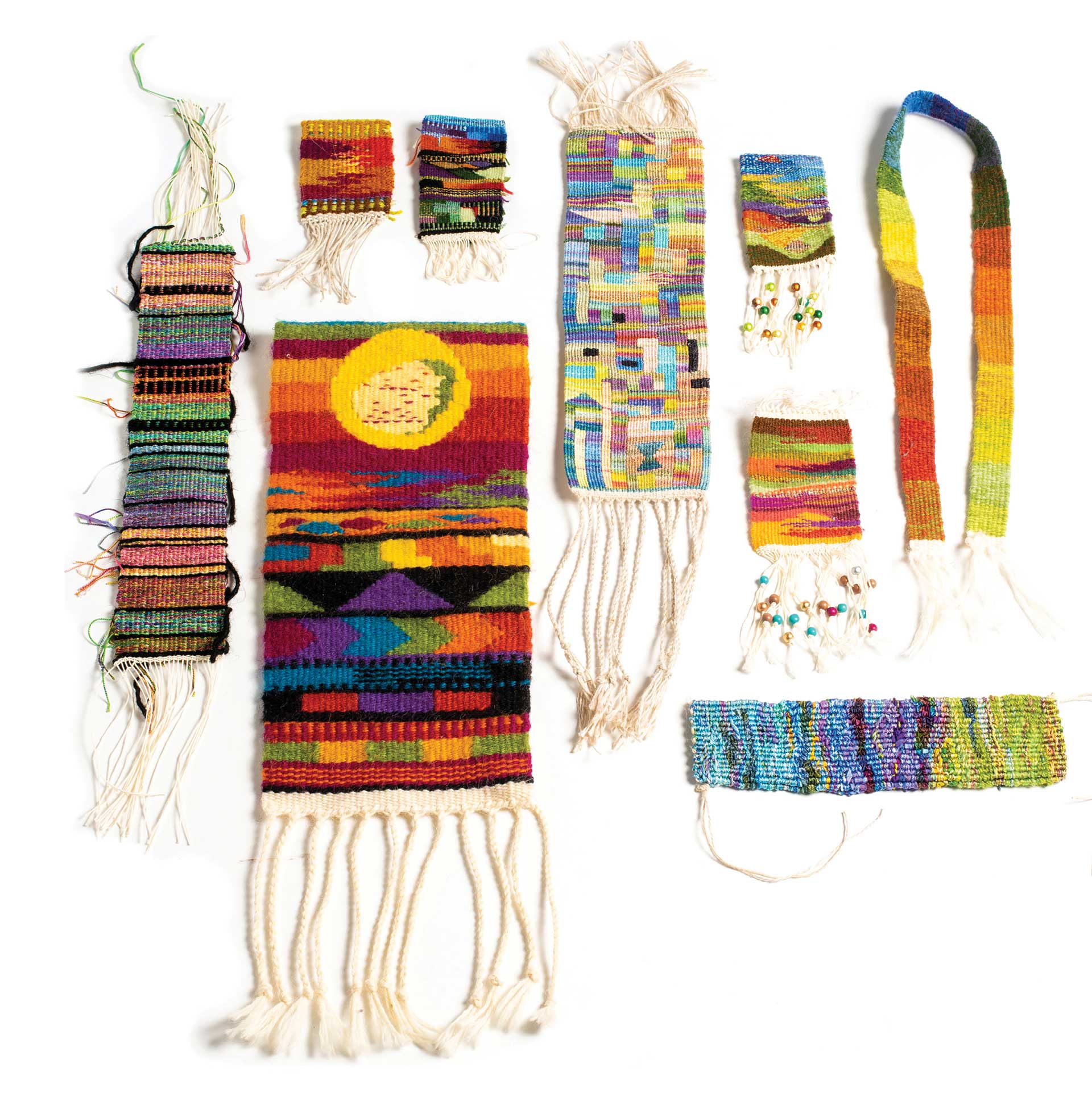
Fill in a blank spot on your wall with a mini tapestry or gift one to a friend.
Traditionally, large floor looms with thick beams, foot treadles, shedding devices, and on-loom tensioning devices were used to weave tapestry. These features are ideal for tapestry weaving, which requires relatively high and even warp tension. Small looms, and even tiny looms, can be just as functional as large ones and often include similar features that allow users to make professional-quality tapestries on a small scale. A small loom that is strong is a must (the high tension of tapestry can cause the side bars of a loom to bow), and we think an on-loom tensioning device is, too. Add-ons such as a foot treadle, shedding device, and variable setts are also wonderful features that make weaving tapestry on any loom, big or small, a little bit easier, but none of those add-ons are absolutely necessary.
When people think of tapestry weaving, they often think of wall hangings, but there are many other uses for tapestry, and plenty are perfect for a portable loom.
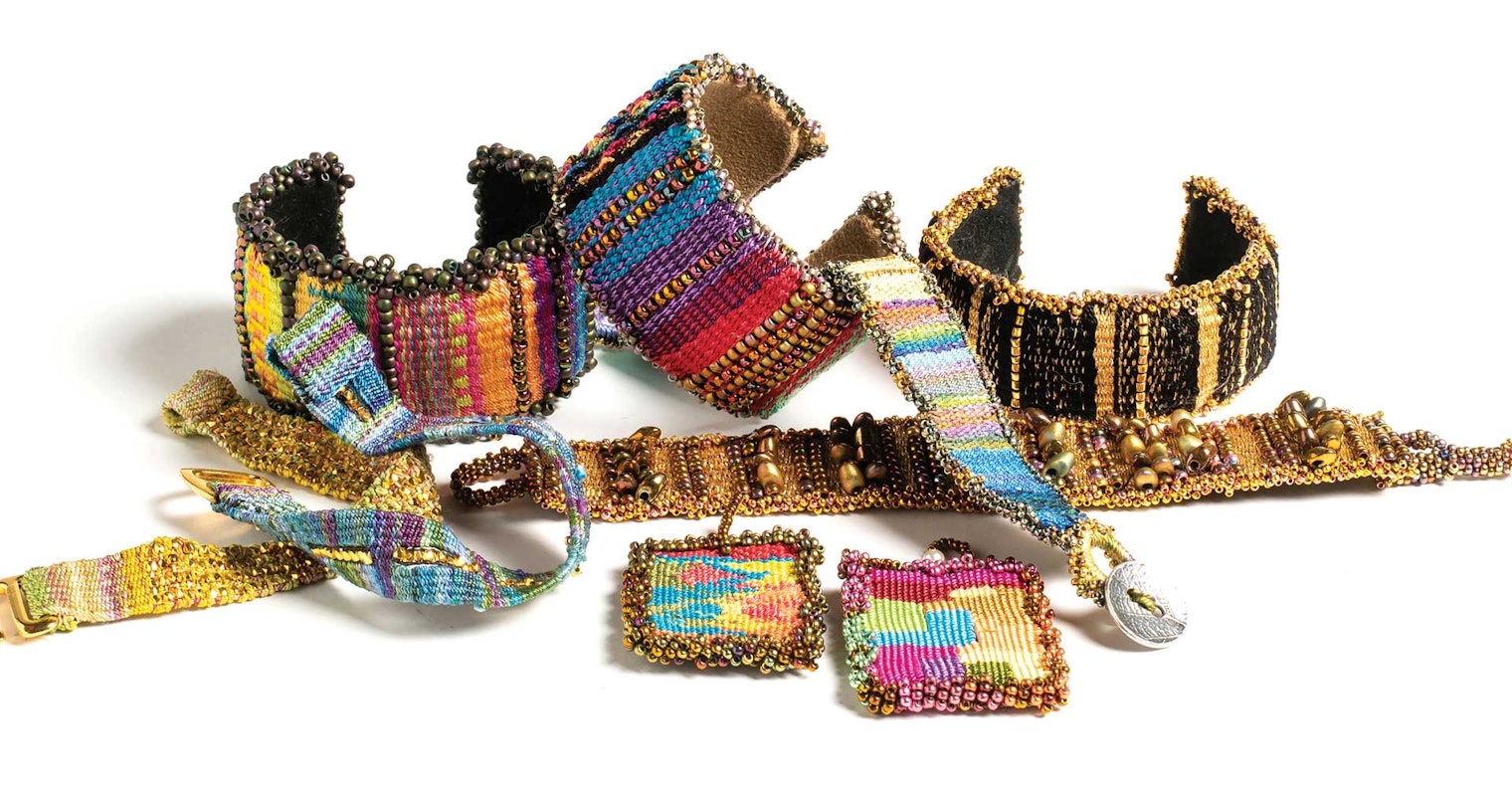
Tapestry jewelry is probably our favorite way to incorporate tapestry techniques on a small scale. Years ago, we stumbled on a project idea that has become a perennial favorite for us to share with new tapestry weavers in kit form, although it‘s easy for even beginning tapestry weavers to design their own. The Tapestry/Bead Cuff Bracelet is a tiny tapestry woven with rows of beads and fun wefts such as variegated silk, railroad yarn, and gold thread all secured to a brass cuff with an Ultrasuede backing. The rows of beads help to keep the weaving from pulling in at the selvedges, a common problem for new tapestry weavers, and the cuff offers an easy framework on which to practice techniques and experiment with textures. Because it’s so small, it’s a great project for using leftover yarn, and the final product will class up any outfit from jeans to a little black dress.
Another category of portable-sized tapestries includes pouches and purses. Tapestry-woven phone cases are a favorite project these days. We have woven phone cases using handpainted silk, wool, cotton, and just about anything beautiful we can get our hands on. Simply weave a piece based on the size of your phone, line it with something soft such as silk or velvet, and voilà, your little tapestry is now functional art—and also a perfect gift!

Use your beautiful works of art to create little bags and cases.
Of course, little wall hangings are the perfect projects for a small tapestry loom. Use them to practice with new warp, weft, or techniques. You can whip off one in a day, string or frame several together, adorn a tiny bare spot on your wall with a wonderful piece of art, or gift it to a friend. For us, giving away our tapestry creations is the perfect way to finish their journeys. We have devoted a lot of weaving time to these little gems—they allow us to keep making and keep giving.
Being a maker is a lifelong gift, and being able to weave on the go makes that gift even better. When you’ve got a loom on your lap and are in the weaving flow, waiting for a tow truck or an unanticipated dental appointment feels less a burden. Remember, glove boxes are not really for gloves and purses are not just for wallets. Make sure you are never stranded without something to make. For us, that means always having a little tapestry loom and a lovely stash of yarn at the ready. Don’t leave home without them!
Claudia Chase and Elena Zuyok are the mother-daughter team behind Mirrix Looms. Claudia founded the company 25 years ago with Elena joining her just over a decade later. Their newest loom is the extra-portable Saffron.
Originally published 6/30/2022; updated 8/7/2024
More from Little Looms
 Skill Guide: A Weaver’s Guide to FiberNo matter what loom(s) you love to weave on, understanding the different characteristics of a fiber can help you make better choices when picking yarns for projects.Christina Garton · July 31, 2026
 Tutorial: Continuous-Strand WeavingLearn the basics of using the continuous strand–weaving method on a pin loom.Jennifer Chapman · July 30, 2026
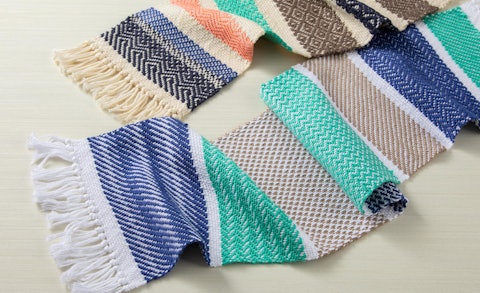 Twill for the Rigid-Heddle Loom: It’s Easier Than You Think!Learn why weavers love twill—and what makes it a great weave for the rigid-heddle loom.Christina Garton · July 14, 2026
 Long Thread Podcast: Angela Tong, Multidisciplinary MakerSeason 14, Episode 7: A jeweler, knitter, crocheter, weaver, and potter sit down for a chat—and it turns out she's the same person. Angela Tong talks about a creative life built on detail, technique, and staying true to her own voice.Anne Merrow · May 2, 2026
 Long Thread Podcast: Heather Torgenrud, Pick-Up BandweavingSeason 14, Episode 4: Although her weaving interests vary from Anne Merrow · March 21, 2026
 Long Thread Podcast: Christina Garton, Little LoomsSeason 14, Episode 2: Ten years since the first issue of Easy Weaving with Little Looms, editor Christina Garton is still finding delightful new ideas in small-loom weaving.Anne Merrow · February 21, 2026
 Weave a Pin-Loom Pet for National Love Your Pet DayWeave a pet—all it takes is a pin loom, a few put-ups of yarn, and a copy of Zoo Crew. Christina Garton · February 12, 2026
 Long Thread Podcast: Laverne Waddington (classic)Season 13, Episode 8: Using her hands, fine threads, and simple tools, Laverne Waddington uses backstrap looms to explore a world of weaving techniques and traditions.Anne Merrow · December 27, 2025
 Skill Builder: Explore Two Takes on Textured WeavesCraving more visual interest in your projects? Try these simple pick-up patterns to add texture to your weaving.Christina Garton · December 18, 2025
 Skill Builder: How to Thread Weaving TabletsLearn how to go from draft to a perfectly threaded set of tablets.Little Looms Authors · November 13, 2025
From the Library




Comments
No comments yet — be the first to share your thoughts.
Sign in to join the conversation — commenting is for signed-in members.