
Loading the latest stories…

Read all about Elisabeth Hill's tips and tricks for avoiding mistakes while weaving, as well as some techniques for fixing errors when they do happen. Learn how to fix broken warp threads, keep your selvedges straight, juggle multiple shuttles, and more!
Elisabeth Hill6 min read
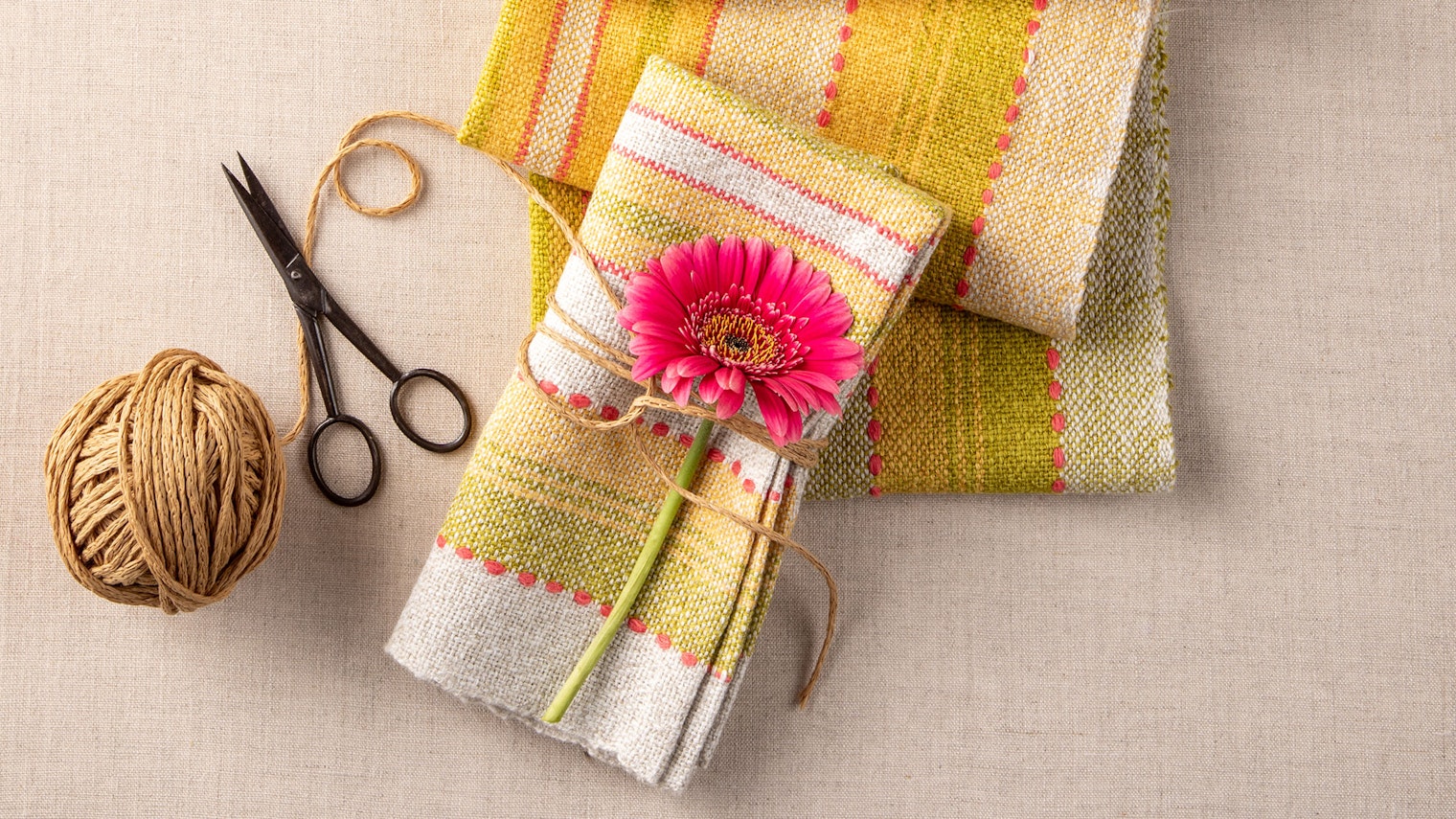
An expert is a man (or woman) who has made all the mistakes which can be made, in (on) a very narrow field (warp)” — Niels Bohr, or, more accurately, maybe if the famous Danish physicist were a weaver.
One of the most satisfying things about weaving is the “ever-receding horizon of learning.” As soon as you feel that you have mastered one technique/fiber/structure, you realize that there is another, and another, and then another, to learn and master.
This makes for a weaving life filled with exciting new challenges. But there is one lesson that seems constant throughout: If you spot a mistake, fix it. Being a good weaver doesn’t mean not making mistakes but, rather, having a formidable tool belt of fixes for the mistakes you do make. Here’s my approach to weaving the Team Colors Scarves.
The number one tip I like to share (half generously and half trying to remind myself) is to observe. At every stage of your weaving, look!
If you practice observing these things, you can often preempt problems down the road down the road (or, as the case may be, down the scarf). But there are always times when something escapes your notice.
If you begin to weave and you notice an unwanted line or gap in your weaving, you may have skipped a slot or hole when threading your heddle. If you have just started weaving your scarf, you will be much happier—although it may also be painful—if you untie the section of warp from the point of the gap to the closest selvedge and re-sley and retie. If you have already woven for a while, and it doesn't disrupt your design too much, you might want to add an extra thread. Here are the steps for adding a thread to your warp:
 Bring the replacement warp thread through your heddle and attach it to your cloth with a T-pin. Photo by Christina Garton
If you have a broken warp end, the repair is pretty similar to the “add an end” above:
 Use a 3" S-hook to weight any added warp threads or increase tension on exissting warp threads. Photo by Christina Garton
If you have just tied on and notice some slack when you bring your heddle forward, simply re-adjust your tie-on knots. (This can still be done even after you've woven several inches, as long as the knots are accessible.) If you are well into your weaving and notice a loose thread, you can hang a 3" S-hook off the errant thread or threads and let it dangle off the back of your loom. This will keep the slack thread or threads under tension and allow you to continue weaving.
Great selvedges are holy grails for weavers (although I have found a few “civilians” who are as keenly sensitive). For weavers, however, selvedge problems are not just aesthetic concerns because they can cause problems while weaving. Here are my tips for better selvedges:
All this said, observation and practice are the keys. The techniques you develop for wool (more elastic) will be slightly different than when weaving with cotton, and the care you may have to use when cutting and tucking ends of a heavy weft may not be necessary when using a fine weft.
 Frequent color changes in the Halcyon Team Colors Home Scarf require planning before starting to weave. Photo by George Boe
Finally, when thinking about how to manage designs with lots of color changes, observation is, again, the key. When I started to weave the Team Colors Scarves , I tried carrying my weft along the selvedge edges rather than cutting and tucking. I decided against carrying, mainly because there were areas with a lot of color changes and areas with few, and I didn't like the variation that would show at the selvedges.
Take the time at the start of your project to try a couple of methods. It may be that you don't mind the carried weft at all, and if you don't, your weaving will certainly go faster.
If you carry your weft up the side, pay attention to shuttle placement. For the Team Colors Scarves, there isn't a right or wrong, but the edges will definitely look better if you place your shuttles consistently (i.e., always keeping one shuttle closest to you and the other shuttle closest to heddle).
 Use the 2-pick trick when you only have two picks of a color and want to hide your ends. Photo by George Boe
Similarly, if you are “cutting and tucking” 2-pick color changes, as in the Halcyon Yarn Team Colors Away Scarf shown above, you may want to use the “2-pick trick” to keep your weft from building up at the edges, especially if you have decided not to unply your yarns at the beginning and ends of color changes. The “2-pick trick” is as follows:
Mistakes are the portals of discovery. — Author James Joyce
*Originally published 6/30/2022; updated 6/11/2025
More from Little Looms
 Skill Guide: A Weaver’s Guide to FiberNo matter what loom(s) you love to weave on, understanding the different characteristics of a fiber can help you make better choices when picking yarns for projects.Christina Garton · July 31, 2026
 From WIF to Woven ClothLearn how to use WIFs and weaving software to create and edit patterns—before you put a single thread on the loom. Christina Garton · July 23, 2026
 Give Yourself the Gift of a Weaving GetawayWhat’s better than learning to master a new weaving? Doing it among friends, new and old! Little Looms Editors · July 21, 2026
 6 Easy Ways to Elevate Your Selvedges with TrimsAdd extra flair to your selvedges and hems with these terrific trims. Christina Garton · July 16, 2026
 Twill for the Rigid-Heddle Loom: It’s Easier Than You Think!Learn why weavers love twill—and what makes it a great weave for the rigid-heddle loom.Christina Garton · July 14, 2026
 A Celebration of Stripes: Call for Submissions Fall 2027We're looking for striped projects of all kinds for our Fall 2027 issue—and that includes plaids and checks, too!Christina Garton · July 9, 2026
 Make Your Own Cardboard Mini-ShuttlesButterflies are beautiful, but they’re not always the best choice when you’re weaving. Try winding small bits of weft on these simple, DIY cardboard shuttles instead!Christina Garton · July 7, 2026
 A Trio of Table ToppersGo beyond rectangular runners with table toppers. Christina Garton · June 30, 2026
 Crochet for Your Selvedges? Your Edges Will Thank YouFind out why Sara Bixler finishes some of her woven pieces with crochet. Watch her free video clip, and then dive into several stitch options to try on your next project. Little Looms Editors · June 25, 2026
 Compose a Masterpiece on Your LoomAfter all, a loom is just another type of stringed instrument. Christina Garton · June 23, 2026
From the Library


Comments
No comments yet — be the first to share your thoughts.
Sign in to join the conversation — commenting is for signed-in members.