
Loading the latest stories…


Learn how to figure out on the fly whether a skein of yarn has enough yards to weave a scarf on either a rigid-heddle or pin loom.
Christina Garton3 min read
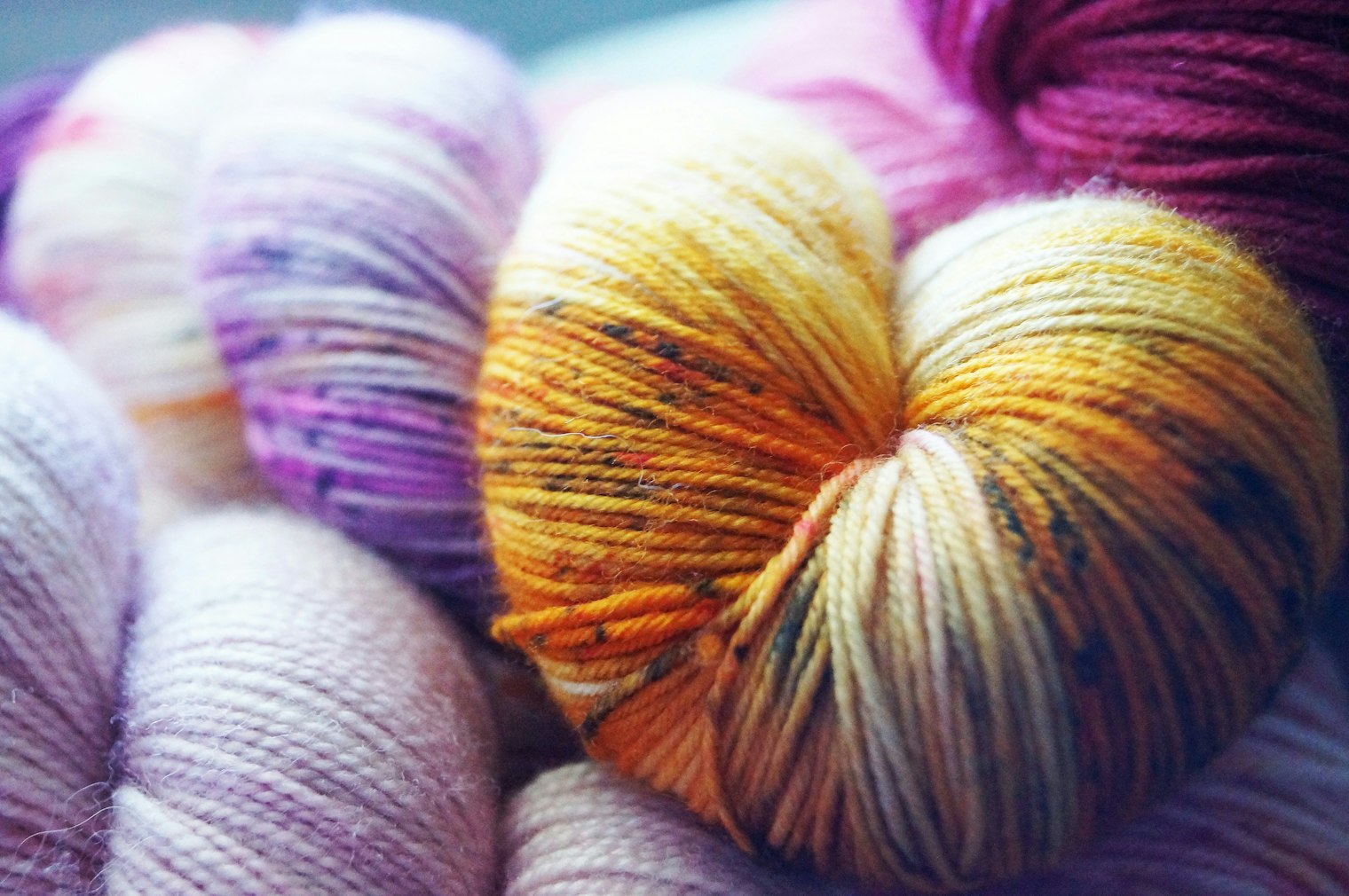
It’s May, which means summer vacations are around the corner—at least for those of us in the northern hemisphere. If, like me, you enjoy stopping at local yarn stores wherever you travel, you might have a souvenir skein or two (or more) in your stash. I know I have [REDACTED] skeins purchased without any purpose in mind. While some eventually make it onto the loom, many more collect dust. What’s a weaver to do?
Recently, I was reminded of a Handwoven website article written by Susan E. Horton about weaving with souvenir skeins. For her article, Susan shared the method she uses when trying to decide whether a particular skein will work for a scarf before she buys it. Not too long ago, the Handwoven team updated it to include rigid-heddle loom. While you can read the original article here, I wanted to share the rigid-heddle information on the Little Looms website and add information for pin-loom weavers, too.
• Warp Length: A 2.5-yard warp is sufficient for a 72″ scarf, allowing 18” for take-up and loom waste, including fringe.
• Warp Width: Scarves are generally between 4″ and 10″ wide.
• Sett: To figure out sett, wrap a few strands around your finger or a ruler to roughly estimate how many strands are in ½″. You can also buy keychain-style wraps per inch rulers or gauges, sometimes also called spinner control tools, which have a 1″-wide indentation for wrapping yarns.
• Weft Yardage: Weft yardage is about two-thirds of warp yardage.
Once you have these numbers, you can start calculating whether that beautiful skein on the shelf will be enough for a scarf by itself or whether you’ll need to buy two skeins or supplement with a secondary yarn.
 A keychain-style wraps per inch gauge, like the one shown here, is a portable tool that can help you figure out a souvenir skein’s sett with ease. Photo credit: Matt Graves
If you want to use the skein only for warp, divide the number of yards in the skein by 2.5 for a rigid-heddle loom. The resulting number divided by your sett will determine your scarf‘s width.
For example, a skein of 250 yards divided by 2.5 yields about 100 warp threads. Sett at 10 epi would result in a 10″-wide warp on a rigid-heddle loom.
Example #1: Warp-Only Estimate
Skein Length: 250 yards
Desired Warp Length: 2.5 yards
Warp Threads Possible: 250 ÷ 2.5 = 100 warp threads
Sett: 10 epi
Maximum Scarf Width: 100 warp threads ÷ 10 epi = 10"
If you want to know how many yards you need for warp and weft, approach the calculation a little differently. Multiply your estimated sett by the desired width, then multiply by 2.5 yards to see how many yards you need for the warp. For the weft, estimate two-thirds of the warp yardage. Add the two numbers together for the total number of yards needed for a scarf.
Example #2: Warp and Weft Estimate
Sett: 10 epi
Desired Scarf Width: 10"
Warp Threads Needed: 10 epi x 10" = 100 warp threads
Desired Warp Length: 2.5 yards
Warp Length Estimate: 100 warp threads x 2.5 yards = 250 yards needed
Weft Length Estimate: 250 x ⅔ = 167 yards needed
Total Yards Needed: 250 (warp) + 167 (weft) = 417 yards
Pin looms are a little more complicated. The yardage needed to weave one pin-loom piece depends on the size and shape of the loom in question. Unless you have the yardages memorized or written down somewhere, there’s no formula or rule of thumb I can find for figuring out yardage for a specific pin loom. That said, I did the math using a variety of shapes and sizes of pin looms with standard setts and figured out that you need about 300 yards to weave a 72" x 8" scarf (not including yarn for joins if you don’t use tails).
If you plan to use a fancier join, such as crochet, that uses more yarn than whipstitch, you’ll want to factor extra yardage in for that as well. For fine sett or extra-fine sett looms, you’ll need even more yardage per piece and per scarf. When in doubt, err on the side of having too much yarn rather than too little.
Happy Weaving!
Christina
More from Little Looms
 Tutorial: Continuous-Strand WeavingLearn the basics of using the continuous strand–weaving method on a pin loom.Jennifer Chapman · July 30, 2026
 Twill for the Rigid-Heddle Loom: It’s Easier Than You Think!Learn why weavers love twill—and what makes it a great weave for the rigid-heddle loom.Christina Garton · July 14, 2026
 Dealing with Selvedges that Go BumpLace weaves are notorious for creating uneven, scalloped, and overall lumpy-bumpy selvedges. Learn two different methods for handling these selvedges in the first installment of our Summer Selvedge Series. Christina Garton · June 4, 2026
 My New Obsession: Three-Color Pick-up on the Inke LoomFind out how this niche Lithuanian technique found its way to America, and why it’s Christina’s new favorite way to create patterns on her inkle loom.Christina Garton · May 5, 2026
 Long Thread Podcast: Angela Tong, Multidisciplinary MakerSeason 14, Episode 7: A jeweler, knitter, crocheter, weaver, and potter sit down for a chat—and it turns out she's the same person. Angela Tong talks about a creative life built on detail, technique, and staying true to her own voice.Anne Merrow · May 2, 2026
 Get Started: Read a Basic Rigid-Heddle PatternHere's what you'll see in a rigid-heddle pattern in Little Looms—and how to translate that information to the loom!Christina Garton · April 23, 2026
 Up Your Design Game with the Fibonacci SequenceLearn how easy it is to design beautiful, asymmetric patterns using a simple bit of math. Christine Jablonski · April 21, 2026
 Perfectly Portable Looms for Weaving on the GoInterested in weaving on small looms? Learn how easy it is to build your own tiny weaving studio and sampler looms using simple household items. Elizabeth Jensen · March 26, 2026
 Join the Band: A New Retreat Just for BandweaversJoin us this fall for four days of bandweaving fun at Band Camp for Weavers!Christina Garton · March 24, 2026
 Long Thread Podcast: Heather Torgenrud, Pick-Up BandweavingSeason 14, Episode 4: Although her weaving interests vary from Anne Merrow · March 21, 2026
From the Library


Comments
No comments yet — be the first to share your thoughts.
Sign in to join the conversation — commenting is for signed-in members.