
Loading the latest stories…

Using Margaret Stump’s project from the Summer 2023 issue as a guide, Christina pairs raffia with 3 different yarns to weave some cute coasters.
Christina Garton3 min read
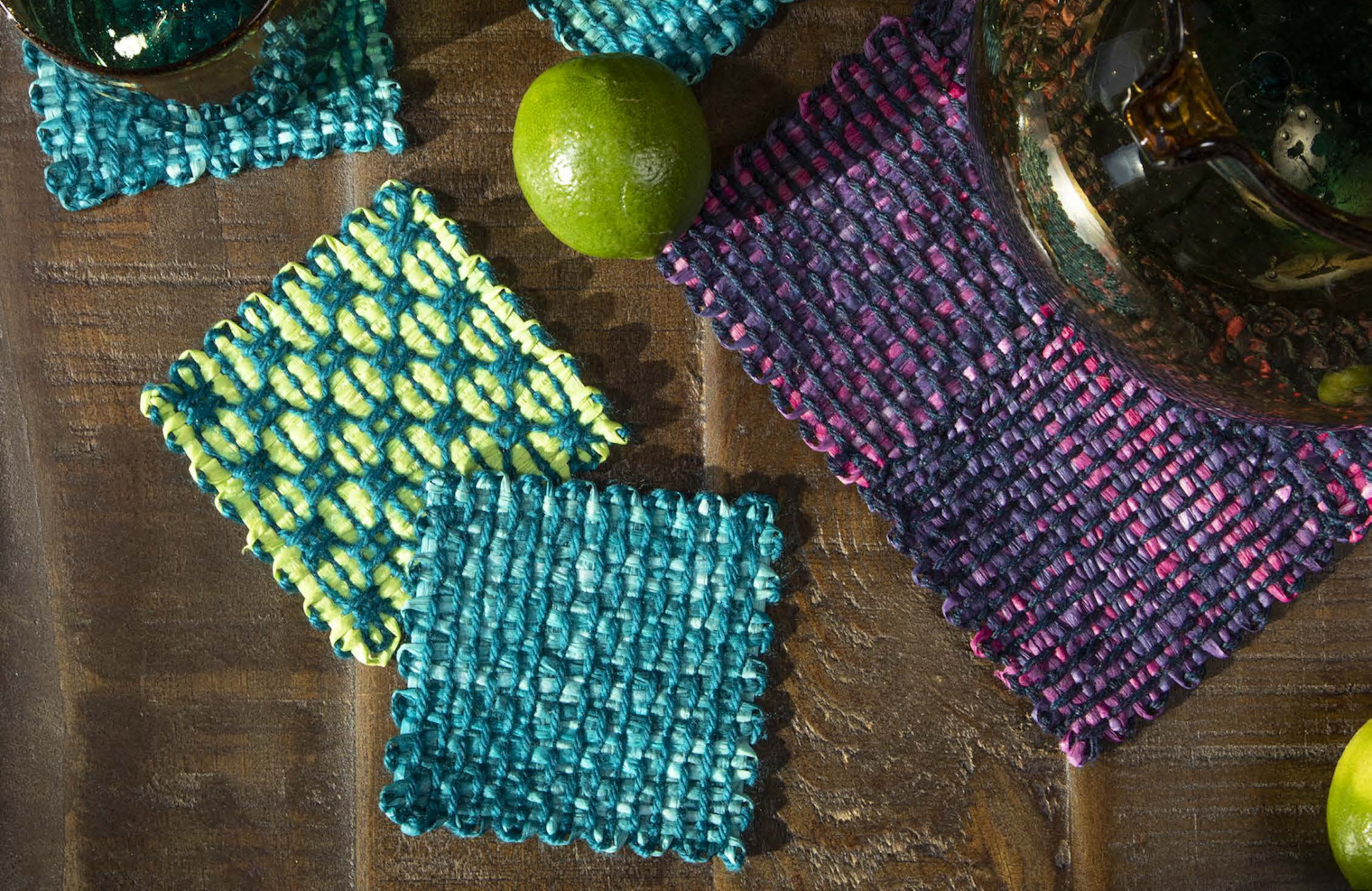
As soon as I saw Margaret Stump’s raffia pin-loom Patio Party Mats in the Summer 2023 issue of *Easy Weaving with Little Looms,* I knew I had to weave up a set of my own. Fortunately for me, I had some of the Ocean Dream raffia Margaret used. Unfortunately, I did not have the non-raffia yarns Margaret used for the last two layers of each coaster. I instead picked out 3 yarns to experiment with: a worsted light blue cotton, a worsted black acrylic, and a DK berry superwash wool blend.
I first tried out the blue cotton using what Margaret calls the basic weave pick-up pattern. While it is not impossible to weave with, the inelastic yarn proved difficult to maneuver around the equally inelastic raffia. My hand ached by the time I was done with the coaster. The coaster is very cute—I love how the blue almost melts into the raffia yarn—but the cotton got placed right back in my stash. Lesson learned: cotton and raffia do not mix on the pin loom.
 On the left is the basic weave coaster Christina wove using cotton; on the right is the honeycomb coaster using black acrylic. Photo credit: Christina Garton
For my second coaster, I went for the black acrylic and gave the honeycomb pick-up pattern a try. Weaving this coaster was an absolute delight. The stretch in the acrylic yarn made all the difference in the world; it was a much easier weaving experience than with the cotton. I love how this coaster turned out aesthetically, too. The way the black contrasts with the variegated blue without overshadowing it—perfection! It has a classy, midcentury-modern vibe that I love.
Next, I gave the berry wool blend a try, also in the honeycomb. As with the acrylic, the elasticity in the yarn made weaving much easier than with the cotton. Colorwise, the berry and Ocean Dream paired beautifully. Unfortuantely, the yarn was just a tad too fine compared to the black acrylic.
 Both coasters woven with the berry wool blend with the basic weave on the left and the honeycomb on the right. Photo credit: Christina Garton
For my fourth and final (for now) coaster, I decided to give the berry a second chance, this time in the basic weave. The difference in how well the two colors worked together in the basic weave vs. the honeycomb surprised me. While the berry yarn elevated the blue in the honeycomb (and vice versa), it stands out too much in the basic weave. I bet if I had the Pink Flash raffia that Margaret also used, it would look beautiful with the berry—I might need to pick up some more raffia for research reasons.
Overall, I loved weaving these coasters (well, maybe not the cotton one). While a coaster of 100 percent raffia might have been a headache, combining it with a more traditional yarn for the last 2 layers made for a pleasant weaving experience with a notoriously tricky fiber. Both pick-up patterns were easy to follow, with the honeycomb having the extra benefit of looking complex (it’s really not!). I’ve got a few more put-ups of yarns in different colors I want to play with, and I’ll absolutely be making a few more of the black-and-blue honeycomb coasters. I might even connect a few to make a snack mat as Margaret did or, dare I dream, a runner for my dining room table.
If you want to give a go at weaving these fabulous and fun Patio Party Mats, check out the pattern in the Summer 2023 issue. If you’re an All Access subscriber, you can take a look at the pattern right now by clicking here.
Happy Weaving!
Christina
More from Little Looms
 Skill Guide: A Weaver’s Guide to FiberNo matter what loom(s) you love to weave on, understanding the different characteristics of a fiber can help you make better choices when picking yarns for projects.Christina Garton · July 31, 2026
 Tutorial: Continuous-Strand WeavingLearn the basics of using the continuous strand–weaving method on a pin loom.Jennifer Chapman · July 30, 2026
 Give Yourself the Gift of a Weaving GetawayWhat’s better than learning to master a new weaving? Doing it among friends, new and old! Little Looms Editors · July 21, 2026
 6 Easy Ways to Elevate Your Selvedges with TrimsAdd extra flair to your selvedges and hems with these terrific trims. Christina Garton · July 16, 2026
 A Celebration of Stripes: Call for Submissions Fall 2027We're looking for striped projects of all kinds for our Fall 2027 issue—and that includes plaids and checks, too!Christina Garton · July 9, 2026
 A Trio of Table ToppersGo beyond rectangular runners with table toppers. Christina Garton · June 30, 2026
 Crochet for Your Selvedges? Your Edges Will Thank YouFind out why Sara Bixler finishes some of her woven pieces with crochet. Watch her free video clip, and then dive into several stitch options to try on your next project. Little Looms Editors · June 25, 2026
 Compose a Masterpiece on Your LoomAfter all, a loom is just another type of stringed instrument. Christina Garton · June 23, 2026
 Two Ways to Make Terrific TasselsTurn loom waste or small bits of extra-special yarns into beautiful, custom-made tassels perfect for trimming handwoven projects and so much more!Christina Garton · June 18, 2026
 An Invitation to SparkleLearn three approaches for using metallic threads to weave fabric that literally shines bright! Christina Garton · June 16, 2026
From the Library




Comments
No comments yet — be the first to share your thoughts.
Sign in to join the conversation — commenting is for signed-in members.