
Loading the latest stories…
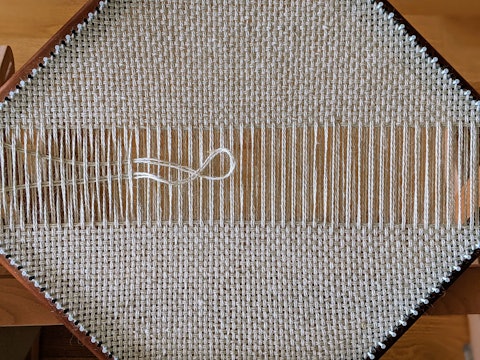
To be honest, as I write this, I’m still weaving my scarf. I brought my loom to work and weave a little each day, mostly in the afternoons when I’m not feeling that lively and need some downtime to process my day.
Susan E. Horton3 min read

To be honest, as I write this, I’m still weaving my scarf. I brought my loom to work and weave a little each day, mostly in the afternoons when I’m not feeling that lively and need some downtime to process my day. That said, I fully intend to finish it by the end of the Team Colors weave-along. I’m just past halfway, and, like a horse going back to the barn, I find that the second half of any project goes faster than the first half. In the first half, I get into a rhythm that carries over into the second.

Weaving at work isn’t the most ideal environment but I’m past halfway now. Photo by Susan E. Horton
I hope you enjoyed planning and weaving your own Team Colors Scarf. I found the pattern a perfect match for the yarn and the sett, which always makes for a more enjoyable weaving experience. It’s always difficult to beat harder or lighter than you are comfortable with—and to remember to do that for 80”. In my last post, I talked about the many ways to finish the fringe on your scarf, but beyond that, there are still a couple of things to do before you wash and dry your scarf.

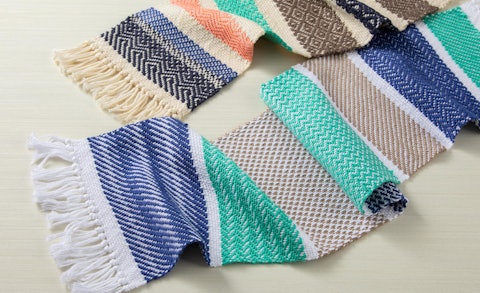
I’m weaving the Jagger Spun Home scarf design using the colorway of the Jagger Spun Away scarf. Photo by George Boe
Don’t be afraid to wash your scarf, but proceed with caution when you do. Here is how Elisabeth Hill, who designed the scarves, approached wet-finishing the Team Colors Scarves:
The rule of thumb that I sometimes wish I had tattooed on my forearm is to start gently. You can always get more aggressive, use hotter water, and agitate more vigorously later, but you really can't go backward if you start hard. With the Team Colors Scarves, even though Jagger Spun Moussam Falls is a superwash wool (which means you can put it in the washing machine and dryer—amazing!), I began by handwashing in warm water with mild shampoo (no sulfates/silicon/parabens, etc.), rinsing, rolling in a towel, and hanging to dry (use wool wash if you have it). They looked pretty good, but I thought both could benefit from a little more vigor, so I put the Jagger Spun Moussam Falls scarves in the washing machine on gentle and in the dryer for 10 minutes. I handwashed the Halcyon Yarn Victorian 2-ply scarves more vigorously, spun them in the washing machine, and put them in the dryer for 10 minutes. Both plumped up nicely, and I was happy with the results.

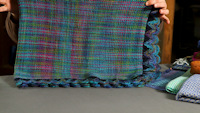
Halcyon’s Victorian 2-ply finishes nicely with a bit more vigorous washing and drying. Photo by George Boe
So, with finishing, as with everything in weaving, the answer is “It depends.” But the good news is that it depends on you—your choices, your preferences, your decisions, and your creativity. After all, isn't that why we are handweavers? If we didn't want to put a little of ourselves into the things we make, then we'd just go out and buy a scarf.
Once you have wet-finished your scarf, you are ready to clip ends and trim any uneven fringe. A rotary cutter and board work well for trimming untwisted fringe, while sharp sewing scissors work well for everything else.
Wrap it up with a big bow! You are ready to start your next project. And someone—it could even be you—is going to be happy with their beautiful Team Colors Scarf. Thanks for being part of the weave-along!
Weave well,
Susan
More from Little Looms
From the Library




Comments
No comments yet — be the first to share your thoughts.
Sign in to join the conversation — commenting is for signed-in members.